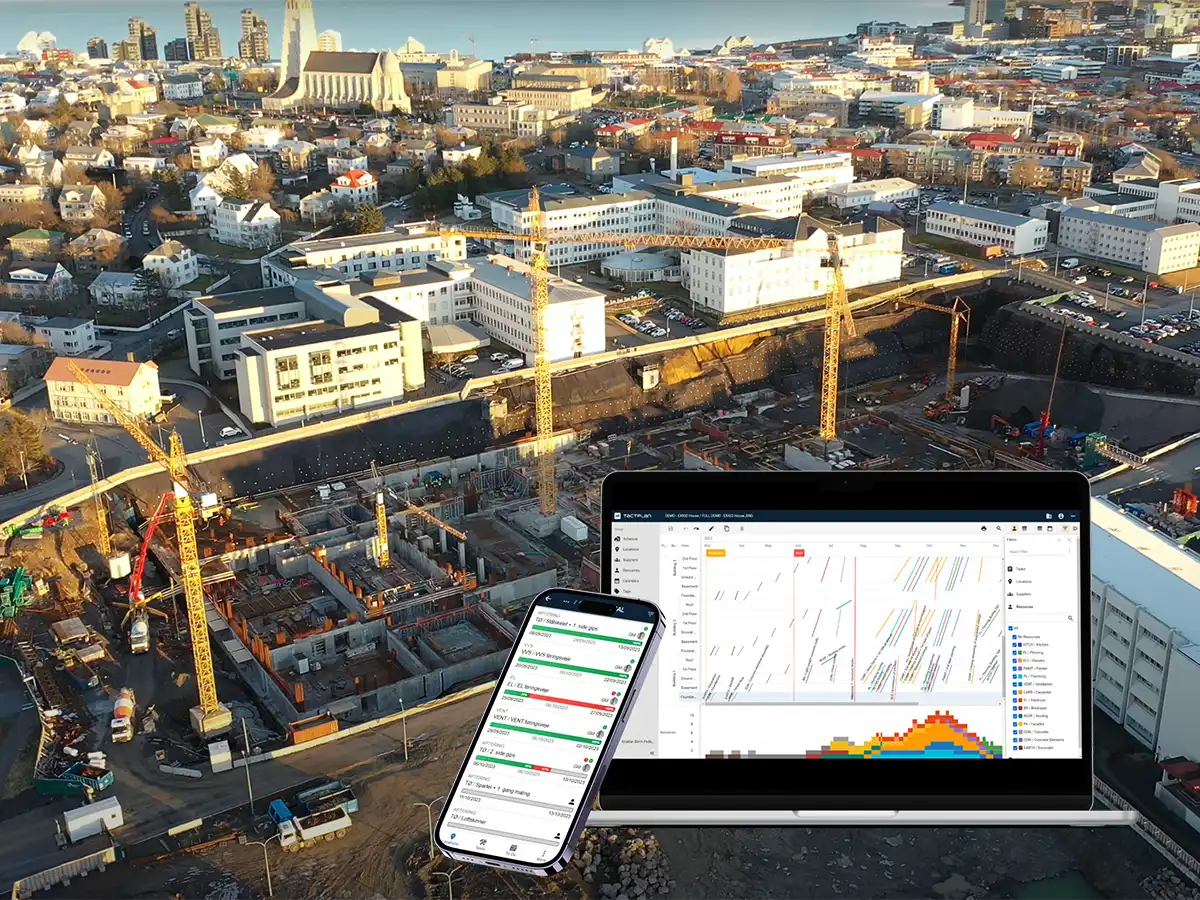
“It is now rare that an NCC construction case is not delivered on time, and good planning is the key!”
This is how Henrik Lindberg, project manager, NCC Building DK, kicked off our discussion about location-based scheduling. Henrik has been at NCC for the past seven years, where he has worked on implementing the LBS method – and it has succeeded!
The newest example is the housing development Nicolinehus in Aarhus: a large new development at Aarhus Docklands totalling 65,000 square metres, and with a total contract sum of approx. DKK 1 billion. This was delivered on time – and according to Henrik, his client Martin Busk from Brix Group is very satisfied.
Tommy Brun Rasmussen, construction manager and building engineer on the Nicolinehus project for NCC, says:
“As I see it, location-based scheduling is the only right way to plan with a billion-kroner project like Nicolinehus. On such large construction projects, you can’t achieve transparency in any other way. It would not be possible with Gantt, for example. At Nicolinehus, our entire schedule was on one A0 sheet. In Gantt, it would fill 50 A0 boards. The fact that you can coordinate all the activities and locations visually makes all the difference. We know exactly where we need to be – and when – with all the activities.”

Tommy has just been on a course in general project management, where the conversation fell on handling milestones, among other things.
“With location-based scheduling, you are gifted with milestones because activities are distributed across locations. And at the same time, you get the opportunity to follow up per location, and for that, we used the app Execute. Here we follow up on status and progress and can document exactly how far we have come at chairman’s and construction meetings. We often find that managers say that now they are done with XYZ, and then we can go into the app right away and check if it’s right. If it is not, we can document the opposite. And then we have to talk about it."
"Previously, I worked on state registration in Excel. One of the challenges with it was that from the time I had registered the stall and went towards the scavenger to enter it into my PC, I was stopped by 4-5 men who all had urgent questions. And before I reached the scavenger, I had almost forgotten that I was in the process of registering a hive."
Everyone agrees that stall registration is important, but it is a lot of work with the “old” method, e.g., using Excel. With the app, you can do it!

Henrik Lindberg goes on to discuss some of the advantages of the method:
“The schedule I’m sitting with now has 25,000 activities. In Gantt, it takes up to 250 pages. The same schedule takes up only ONE page in the location-based schedule. And on the one hand, I have a visual overview of my entire schedule.”
Henrik continues:
“With the method, I get an overview of where the challenges in my schedule lie. That is the most important advantage, I think. In practice, this means that when I use the method, I am also presented with a continuous risk analysis of my schedule. As I plan, I immediately get an overview of the challenges the schedule contains. And because the method is so visual and simple to adjust, it is easy to solve the challenges on an ongoing basis.”

There is one common reservation regarding the LBS method which we ask Henrik about:
“Is it true that Location-based scheduling only works when there are many repetitions?”
Henrik replied, “No, that’s not true. Regardless of whether it is a residential building with 500 identical staircases, or whether it is a complex construction with many different locations, location-based scheduling is completely different, as it gives you a visual overview of where the challenges in the schedule are using this method."