When a construction project goes over budget, the first instinct is to look at the numbers. Were the estimates too optimistic? Did material costs spike? Was there an unforeseen ground condition?
Sometimes, yes. But in the majority of cases, the budget was never the real problem. The real problem was the plan.
Construction cost overruns are, more often than not, the financial consequence of a coordination failure that nobody caught in time — a schedule deviation that seemed small until it cascaded, a delay that became visible in the accounts only after the chance to address it had passed. This post examines why that pattern repeats, what the mechanism actually is, and how a more structured approach to location-based scheduling creates the financial stability that no budget spreadsheet can provide on its own.
Time and Money Are the Same Problem
A schedule delay is not just a planning inconvenience. It is a budget event. Every additional day on site means supervision, temporary facilities, and equipment running at full cost. It can push a trade contractor into conflicting commitments, triggering either a resource gap or an overtime premium. When the delay compounds — as it nearly always does when trades are sequentially dependent — the financial exposure grows quickly.
The challenge is that the full cost rarely surfaces until it has already materialised. By the time extra invoices arrive, idle crew costs accumulate, or a payment is withheld, the decision window has long closed. The pattern repeats across project types, company sizes, and geographies — not because budgets are poorly constructed, but because the plans behind them do not give anyone reliable early warning.
Thomas Høyer, Owner at TT Høyer Entreprise ApS, has encountered that challenge many times throughout his career. Having managed complex construction projects over many years, his experience points consistently to the same root cause: the plan did not hold, and by the time that was clear, the cost was already there.
Why the Budget Gets the Blame
When a project finishes over budget, the post-mortem usually focuses on the estimates. Were contingencies sufficient? Was scope creep managed? These are reasonable questions — but they tend to address the symptom rather than the cause.
The underlying cause, in most cases, is a planning approach that does not give anyone a reliable picture of what is happening on site until it is too late to act. A traditional schedule tells you what should be happening on a given date. It does not reliably show where on the site that activity is happening, how it interacts spatially with adjacent trades, or what a single day's slip will mean for the fifteen activities that follow.
That gap between schedule and reality is where most budget pressure originates. Not in the estimates. In the plan.
How Location-Based Scheduling Protects Your Budget
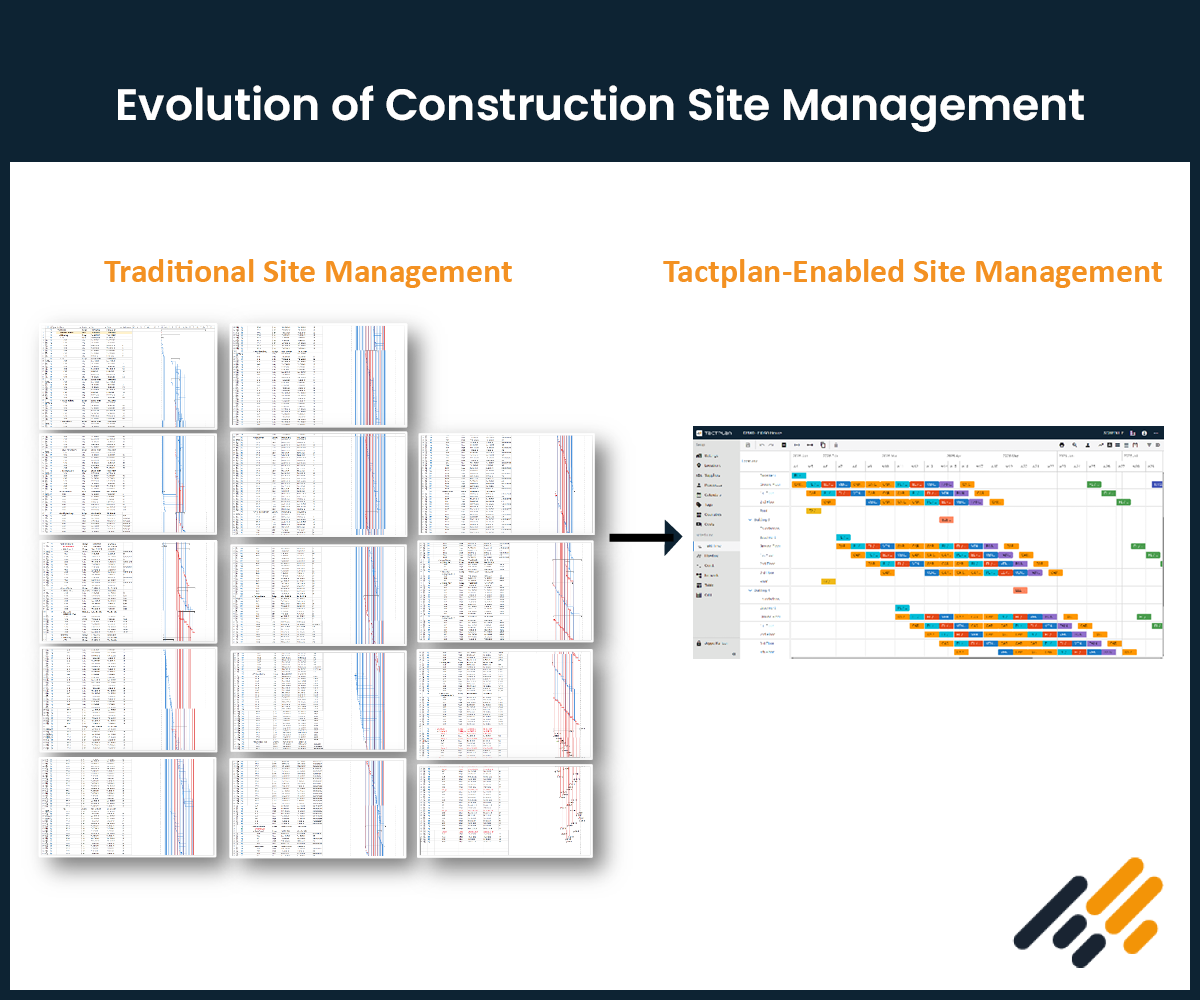
Location-based scheduling addresses the root cause directly. Instead of planning activities only across time, it plans them across both time and physical location — floors, zones, or any spatial breakdown that reflects how the building actually gets built. Every trade has a defined workspace and a defined timeframe. Clashes are visible before they happen. A delay in one area immediately shows its downstream consequence across the full schedule.
That spatial visibility is what turns a scheduling method into a financial management tool. When consequences are visible early, decisions are cheaper.
See the Consequence Before It Becomes a Cost
Theis Ballegaard, Project Manager at Oskar Group, describes the difference plainly. On a traditional schedule, the impact of one trade falling behind often stays hidden until it has already disrupted others. With flowlines, the consequence is immediate and visual — and that changes the conversation.
"If the carpenter is two days late, I can show him the consequence of his delay. It may well be that his work takes longer than expected, and it may be quite real — but the important exercise is to show him the consequences. When I show the carpenter the consequence, he can understand it. It is easy to visualize the consequence for him with flowlines."
— Theis Ballegaard, Project Manager, Oskar Group
A trade contractor who can see a multi-week downstream consequence of a two-day delay responds differently to one who simply receives a complaint. The conversation shifts from blame to problem-solving — and the cost of the problem stays manageable.
Stable Flow Eliminates Hidden Costs
One of the least visible budget pressures in construction is the cost of uncertainty. When trade contractors cannot rely on a stable, predictable workflow, they price that uncertainty into their bids — through contingency margins, through premium rates for short-notice mobilisation, or through the cost of sending crews to a site where the predecessor has not finished.
Simon Grønhøj Jensen, Construction Manager at Eurodan-huse, describes what reliable planning makes possible on a 31-home development delivered one month ahead of schedule in phase one and two months early in phase two:
"I can guarantee the painter that he doesn't have to drive in vain because the previous contractor isn't finished on time. He can have three workers consistently on-site, and they can work undisturbed from house 1 to 31 in the two months we've agreed upon."
— Simon Grønhøj Jensen, Construction Manager, Eurodan-huse
A trade contractor who trusts the schedule does not need to price in uncertainty to the same degree. That stability has a direct financial benefit for every party in the supply chain. You can read more about the economics of workflow reliability in our post on construction efficiency.
.webp)
Documentation Failures Can Withhold Payment
The financial stakes of coordination failure have grown as documentation requirements for fire safety, commissioning, and technical handover have become more demanding. A single incomplete activity can now block an entire approval sequence — and with it, the client's right to take possession.
Nina Fogh-Andersen, Site Manager at Arpe & Kjeldsholm, managed exactly this on a project in Carlsberg Byen where construction and technical schedules were integrated into a single location-based plan.
"A carpenter might ask whether he can wait a week before fitting the door leaves. Previously, I might have said yes. But now, with the full overview in place, I can see that measurements in the stairwell are already planned for tomorrow. If even a single door leaf is missing, the test cannot be carried out. And if the documentation is not in order, the client is fully entitled to withhold payment."
— Nina Fogh-Andersen, Site Manager, Arpe & Kjeldsholm
The project was delivered on time. Documentation requirements were met. The client received the keys when they were supposed to.
One Meeting, DKK 85,000 Saved
Documentation does not just protect the client — it protects the contractor. When progress is recorded with timestamps and site registrations, disputes about who finished what and when resolve quickly, before they accumulate into claims.
Kristine Ann Barnes, former Process Consultant at Niras, experienced this directly:
"I 'earned' DKK 85,000 for the project in just 5 minutes during my meeting with the trade contractor in the construction trailer — and that's just one of many examples."
— Kristine Ann Barnes, former Process Consultant, Niras
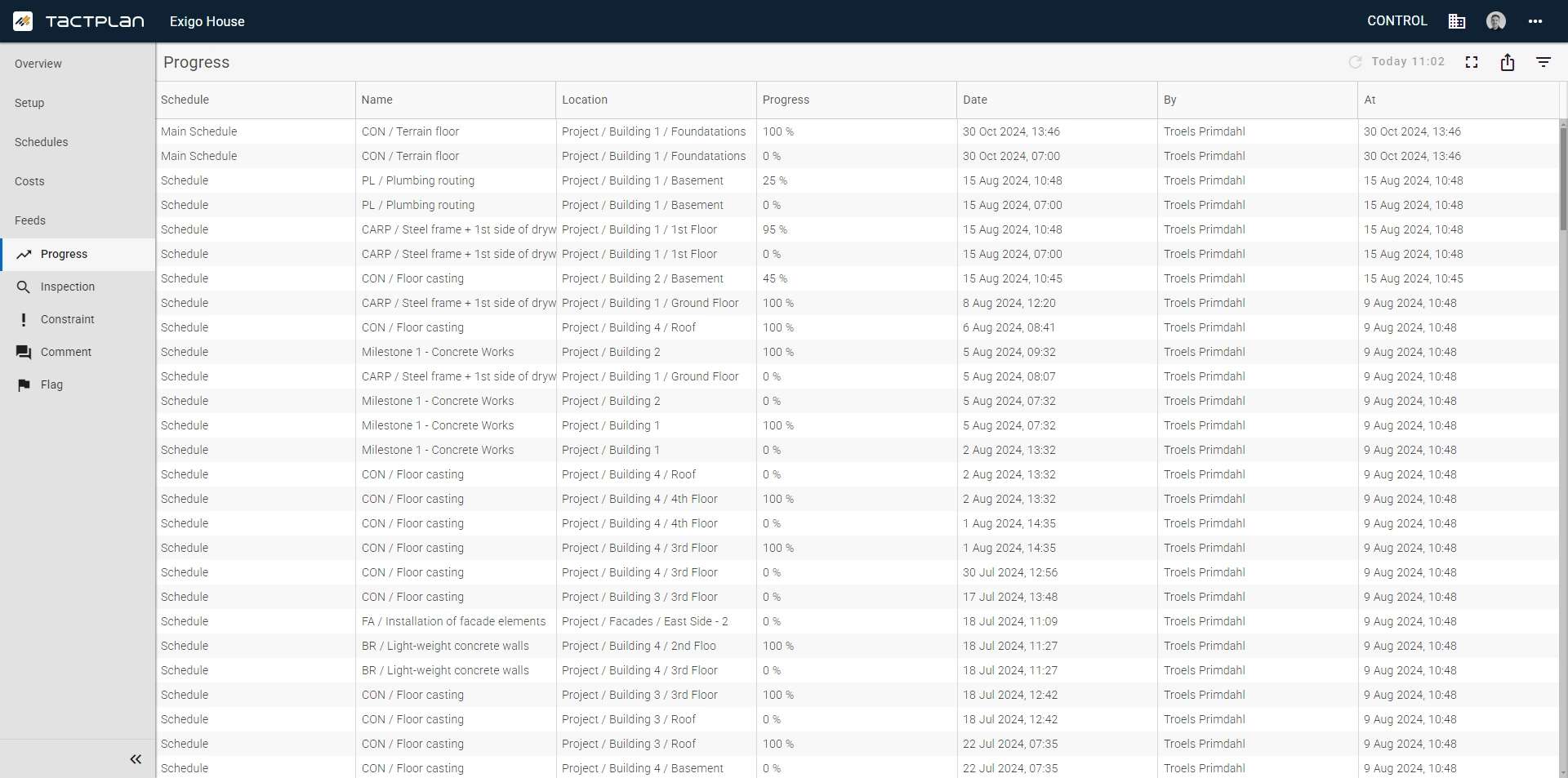
That outcome is not a lucky coincidence. It is what happens when progress tracking is built into the planning method from the start — so the data exists when it is needed.
The Plan Is the Budget's Best Protection
Budget overruns in construction are overwhelmingly a planning problem. Trades conflict because no one has a shared spatial overview. Problems compound because they are identified too late. Trade contractors price in uncertainty because they cannot rely on stable workflow. Payments are withheld because documentation prerequisites are missed in the sequence.
None of these start as budget failures. They start as coordination failures — and coordination is a planning problem with a proven, practical solution.
If you are responsible for delivering projects on time and within budget, the most effective step you can take is to make consequences visible before they become costs.
Book a demo or start a free trial with Tactplan and see how project directors are building financial predictability into every project from day one.