Most construction projects do not go wrong because people work too little. They go wrong because the plan stops matching reality on site, and nobody sees it in time. A trade arrives to an area that is not ready. A delay in one zone quietly pushes three others. By the time the consequences reach the project meeting, the options have narrowed and the costs have grown.
Construction project management is the discipline that prevents this. It is the craft of turning drawings, contracts, and dozens of independent trade contractors into one coordinated production, delivered on time and within budget.
This guide explains what construction project management covers in practice: the project lifecycle, the core disciplines, the planning methods that create predictability, and the habits that experienced project directors rely on. It draws on more than fifteen years of hands-on planning experience from real construction sites.
What Is Construction Project Management?
Construction project management is the planning, coordination, and control of a construction project from early design decisions to final handover. The goal is simple to state and hard to achieve: deliver the agreed scope at the agreed quality, on the agreed date, at the agreed cost.
What makes construction management different from generic project management is the nature of the production itself. A construction site is a temporary factory built around the product. Dozens of trade contractors share the same physical space, in a fixed sequence, under changing weather, on a product that is built exactly once. When one trade slips, the effect travels through every trade that follows it in that space.
That is why the heart of construction project management is not paperwork. It is coordination: making sure every crew has a free workspace, the right materials, and a realistic timeframe, every single day of the project.
In practice, the responsibility is shared. The project director owns the overall commitment to the client and to management. The project manager and site manager turn that commitment into a working plan. The foremen and trade contractors make the plan real, one location at a time. Good construction project management gives all of them the same clear picture of the project.
The Construction Project Lifecycle
Every construction project moves through the same broad stages: initiation, planning, execution, monitoring and controlling, and closeout. Each stage has its own decisions, risks, and deliverables, and the quality of the early stages largely determines how calm the later ones will be.
We have covered each stage in depth in our guide to the six phases of construction project management, so this article will not repeat that ground. What matters here is the connection between the stages. Initiation sets the frame that planning has to work within. Planning determines whether execution can run in a steady flow or will be a series of rescues. Monitoring decides whether deviations are caught while they are small. And closeout is where every earlier shortcut presents its invoice.
The short version: the plan you build before crews arrive is the foundation for everything that follows. Weak planning cannot be repaired by heroic execution.
The Core Disciplines of Construction Project Management
Delivering on time is not the industry norm. In KPMG's 2023 Global Construction Survey, only about half of the owners and contractors surveyed reported completing their projects on schedule. The difference between the projects that deliver and the projects that drift usually comes down to how well the core disciplines are handled.
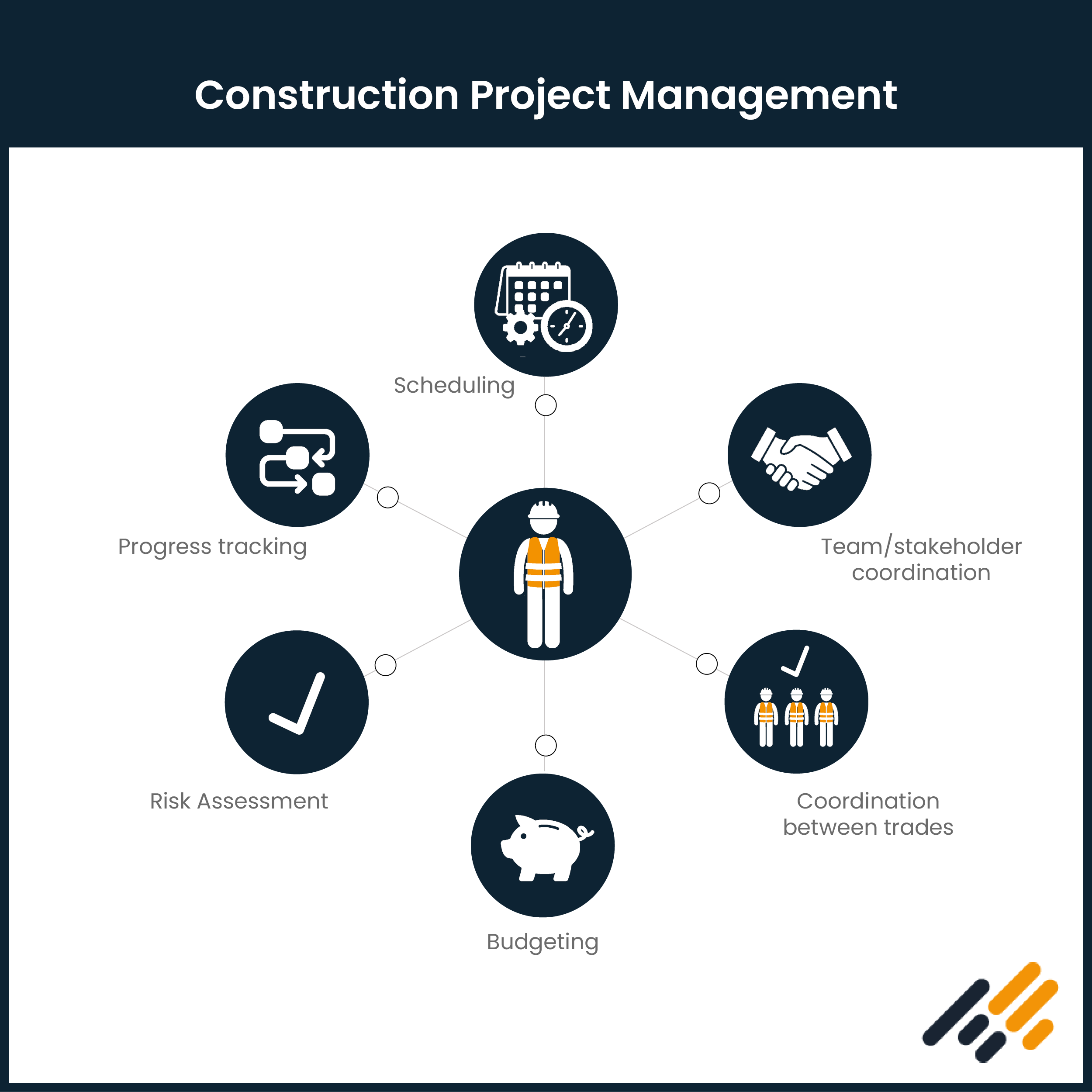
Scheduling. The schedule is the backbone of the project: it defines who works where, and when. Methods range from the critical path method to location-based approaches, and what matters most is that the schedule reflects how the site actually produces, not just how the contract is structured. Our complete guide to construction scheduling covers the methods in depth.
Team and stakeholder coordination. A construction project answers to more than the trades on site: owners, architects, consulting engineers, and authorities all expect clear, timely information. Keeping this wider group aligned, with the same facts the site is working from, prevents the kind of misunderstandings that cost time later in approvals and sign-offs.
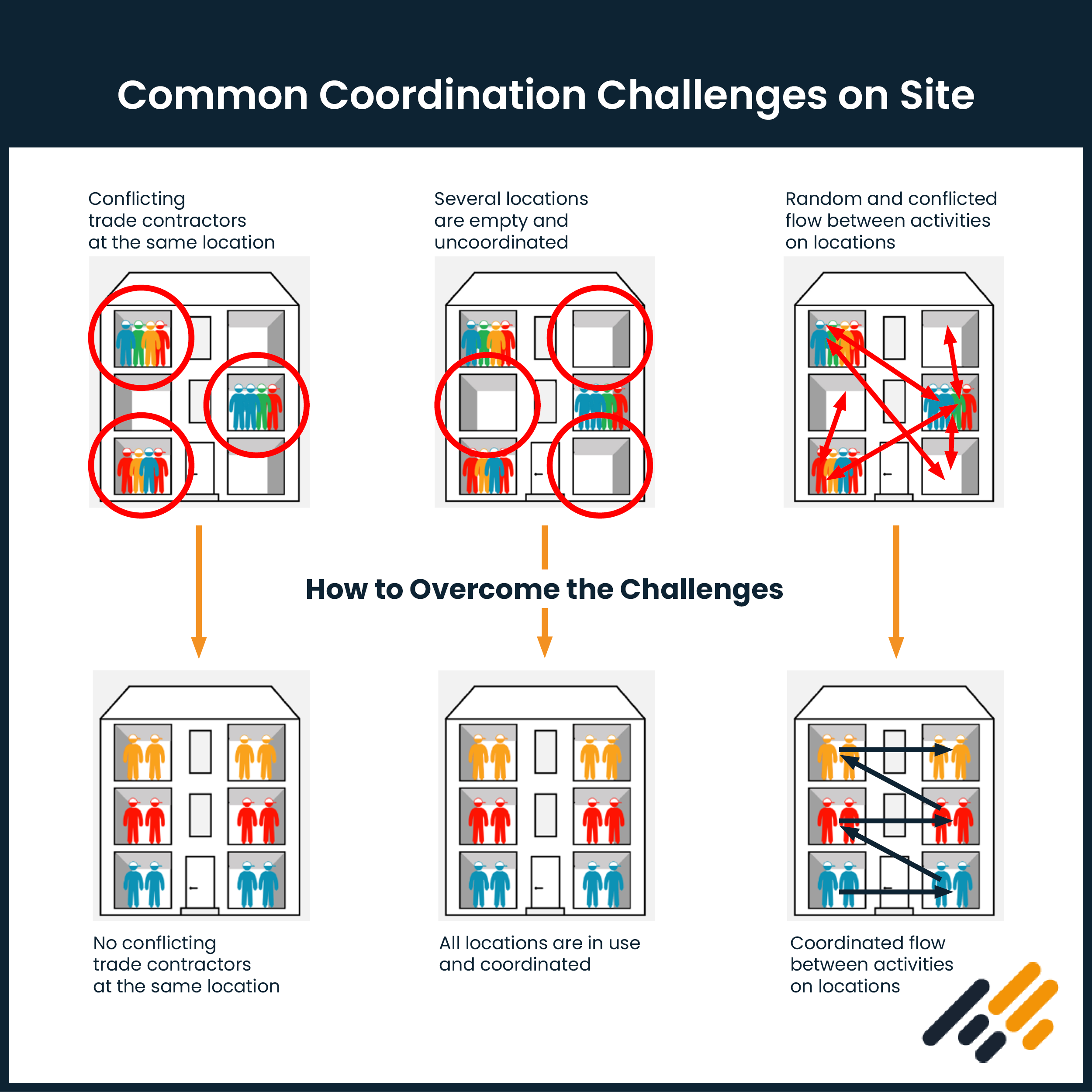
Coordination between trades. Most delays are not caused by slow work but by trades waiting for each other, or working on top of each other. Good coordination gives every trade contractor a defined workspace and an undisturbed window to complete it.
Progress tracking. A plan is only useful if you know where the project actually stands against it. Systematic progress tracking, location by location, turns vague status reports into precise knowledge, and it catches deviations while they are still small and cheap to correct.
Risk management. Every schedule contains risk: weather, deliveries, design changes, approvals. The discipline is not to eliminate risk but to see it early, understand its consequences, and keep realistic buffers where they protect the flow.
Budget management. Time and money are two views of the same project. Every day of delay carries a cost long before it appears in the accounts, which is why schedule control and cost control belong in the same conversation.
How Location-Based Scheduling and Takt Planning Fit
Traditional schedules plan activities across time. Location-based scheduling plans them across both time and place: floors, zones, stairwells, or whatever spatial breakdown matches the building. Each trade's work appears as a flowline moving through the locations, so clashes, gaps, and collisions between trades become visible before they happen on site.
Takt planning adds rhythm to that picture. Work is structured so crews move through the zones at a steady, repeatable pace, like a production line where the product stands still and the teams move. The result is a stable flow: trade contractors know when their zone will be ready, materials arrive when they are needed, and the plan holds because it was realistic from the start.
Consider a familiar situation. The carpenter falls two days behind on the third floor. In a traditional schedule, the consequence surfaces weeks later, when the electrician and the painter arrive to locations that are not ready. In a location-based schedule, the collision is visible the moment the delay is registered, while there is still time to add crew, resequence, or use a buffer location. The problem is the same; the difference is when you see it.
Both methods grow out of lean construction thinking, where the focus is flow and reliability rather than pressure and firefighting. For a project director, the practical benefit is a schedule that answers the questions that matter daily: who is where, what happens if this slips, and where do we intervene first.
Practical Tips for Effective Construction Project Management
Method matters, but so do habits. Research from the Project Management Institute has consistently shown that organisations with mature, disciplined project management practices waste dramatically less of their project budgets than those without. On a construction site, that discipline looks like this:
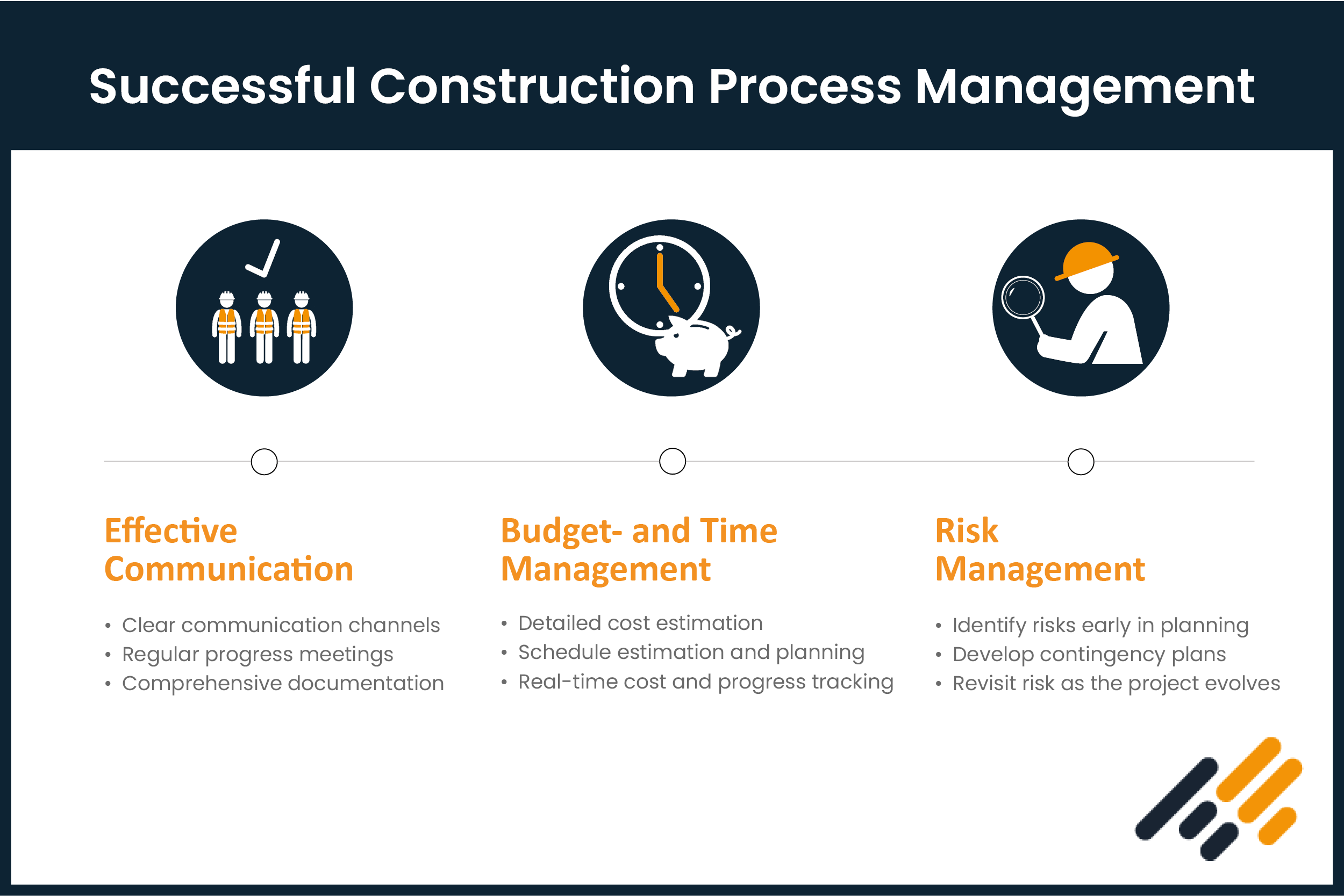
- Set clear goals and realistic timelines. An optimistic schedule is not ambitious; it is a delay that has not happened yet. Plan from real production rates.
- Work from one shared plan. When office and site work from different versions of the schedule, coordination becomes guesswork. One plan, visible to everyone, is worth more than ten perfect reports.
- Communicate consequences, not blame. When a trade slips, show what the delay means for the trades that follow. Consequences persuade where pressure fails.
- Build a competent team and delegate deliberately. Assign responsibility along lines of expertise, and make handovers between trades explicit rather than assumed.
- Track progress against locations, not just percentages. Sixty percent complete hides problems; zone four is two days behind points to the solution.
- Protect the rhythm with buffers. Something unexpected always happens. Deliberate buffers absorb it without breaking the flow of every following trade.
None of these habits require new technology. All of them become far easier when the schedule itself is built to show locations, consequences, and flow.
Common Challenges, and How Planning Addresses Them
A few challenges dominate most project directors' days, and all of them respond to the same medicine.
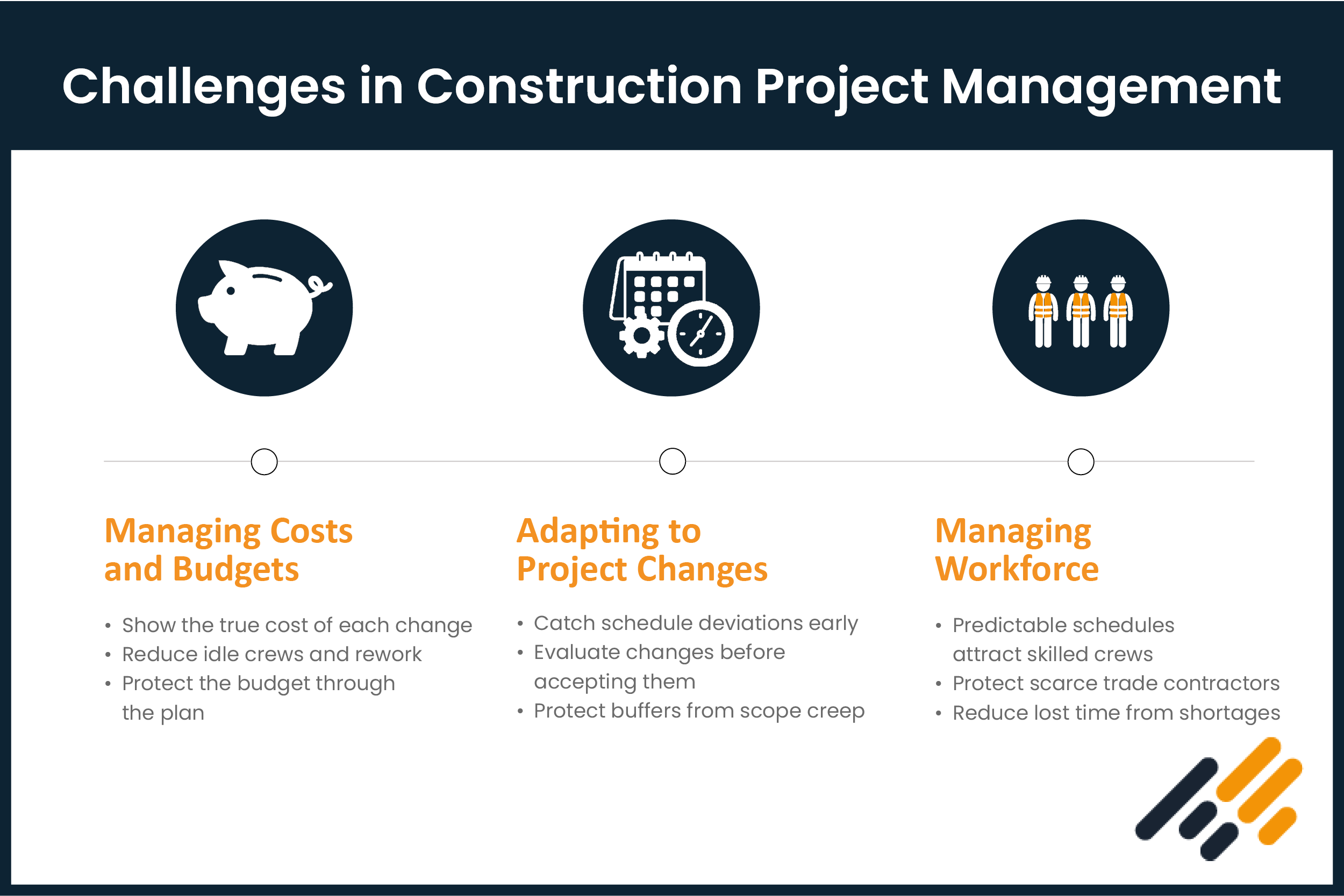
Scope creep. Small changes accumulate. Each seems reasonable in isolation; together they consume the buffers and quietly rewrite the schedule. The defence is a plan precise enough to show the true cost of each change before it is accepted.
Budget overruns. Overruns rarely start in the budget. They start in the plan, as idle crews, repeated mobilisations, and compressed end phases where quality and economy are traded away under time pressure. By the time an overrun is visible in the accounts, its cause is usually weeks old. Catching the schedule deviation early is the cheapest form of cost control there is.
Labour shortages. The people problem is structural. In the 2025 workforce survey from the Associated General Contractors of America, 92 percent of construction firms reported difficulty finding the workers they need, and nearly half said shortages were already delaying projects. When skilled crews are scarce, wasting their time on a poorly coordinated site is a cost few projects can absorb. Predictable, well-sequenced work is also a genuine advantage in attracting good trade contractors: crews prefer sites where they can work undisturbed and plan their own economy with confidence.
What This Looks Like in Practice
The experiences below come from project managers on real construction sites who plan their projects with location-based scheduling.
For Nina Fogh-Andersen, Site Manager at Arpe & Kjeldsholm, the value showed on a project in Carlsberg Byen where documentation requirements for fire safety and commissioning determined whether handover could happen at all:
“The new documentation requirements demand tighter control. But in return, I can guarantee the client that the new documentation requirements will not affect the move-in date.” — Nina Fogh-Andersen, Site Manager, Arpe & Kjeldsholm
For Theis Ballegaard, Project Manager and Construction Site Manager at Oskar Group, the decisive capability is impact analysis: seeing what a change means for everyone else before deciding.
“I could never do the impact analyses that promote good collaboration to such an extent with Gantt.” — Theis Ballegaard, Project Manager and Construction Site Manager, Oskar Group
And for Kristian Krabbe, Project Manager at JCN Bolig, the starting point was overview:
“Gantt makes it challenging to maintain a complete overview.” — Kristian Krabbe, Project Manager, JCN Bolig
Three different companies, three different project types, one common thread: predictability comes from a plan that shows locations, consequences, and flow. None of these project managers describe working harder than before. They describe seeing earlier, deciding calmly, and being able to stand behind the dates they promise.

From Plan to Predictable Delivery
Construction project management is, at its core, the discipline of keeping a complex production predictable: a realistic plan, clear coordination between trades, honest progress tracking, and the judgment to act on deviations while they are still small.
This is the methodology Tactplan is built on. Developed from more than fifteen years of hands-on planning experience on real construction sites, Tactplan combines location-based scheduling, takt planning, and Gantt in one clear picture, so project directors can manage time, trades, and consequences from a single page. You can read more about how it supports construction management in daily production.
If you want to see what your next project looks like as a location-based plan, book a demo or start a free trial.