The Five-Year Vision: From Planning Tools to Project Ecosystems
When Kristian Birch Pedersen envisions construction scheduling five years from now, he doesn't describe autonomous AI systems running projects. Instead, he sees something more fundamental: complete integration.
"More connected to quality management—or we'll have quality management embedded. Fully integrated with the cost, both planned and actual. Fully integrated with the ERP system, or it will be the ERP system," he explains. The scheduling platform won't be one tool among many — it will be the central nervous system connecting every aspect of project management.

This isn't distant speculation. The building blocks exist today. What changes over the next five years is depth of integration and breadth of adoption. "The experience will emphasize real-time feedback and forecasting," Birch Pedersen predicts, but human collaboration remains central.
His vision of perfect collaborative scheduling is already close to reality: "A digital online tool that's easy to use, used in meetings every Tuesday and Thursday, used for real-time data collection." The goal is to make this method work on far more projects than is the case today."
This future isn't waiting for breakthrough technology or years of development. The tools exist today. The methodologies are proven. What's needed now is implementation — moving from theoretical understanding to practical adoption on real projects.
Want to jump into the future now? The transition starts with understanding how these systems work in practice. You can explore Tactplan's free online academy to see the technology firsthand, or continue reading below to discover real-life examples of contractors who've already made the leap — delivering hotels on time without overtime, finishing residential projects two months early, and saving weeks on every schedule.
The future Birch Pedersen describes isn't coming — it's already happening on construction sites across the world. The question is whether your organization will lead this transition or follow behind competitors who've already captured the benefits.
Where AI Actually Helps: Solving the Boring Stuff
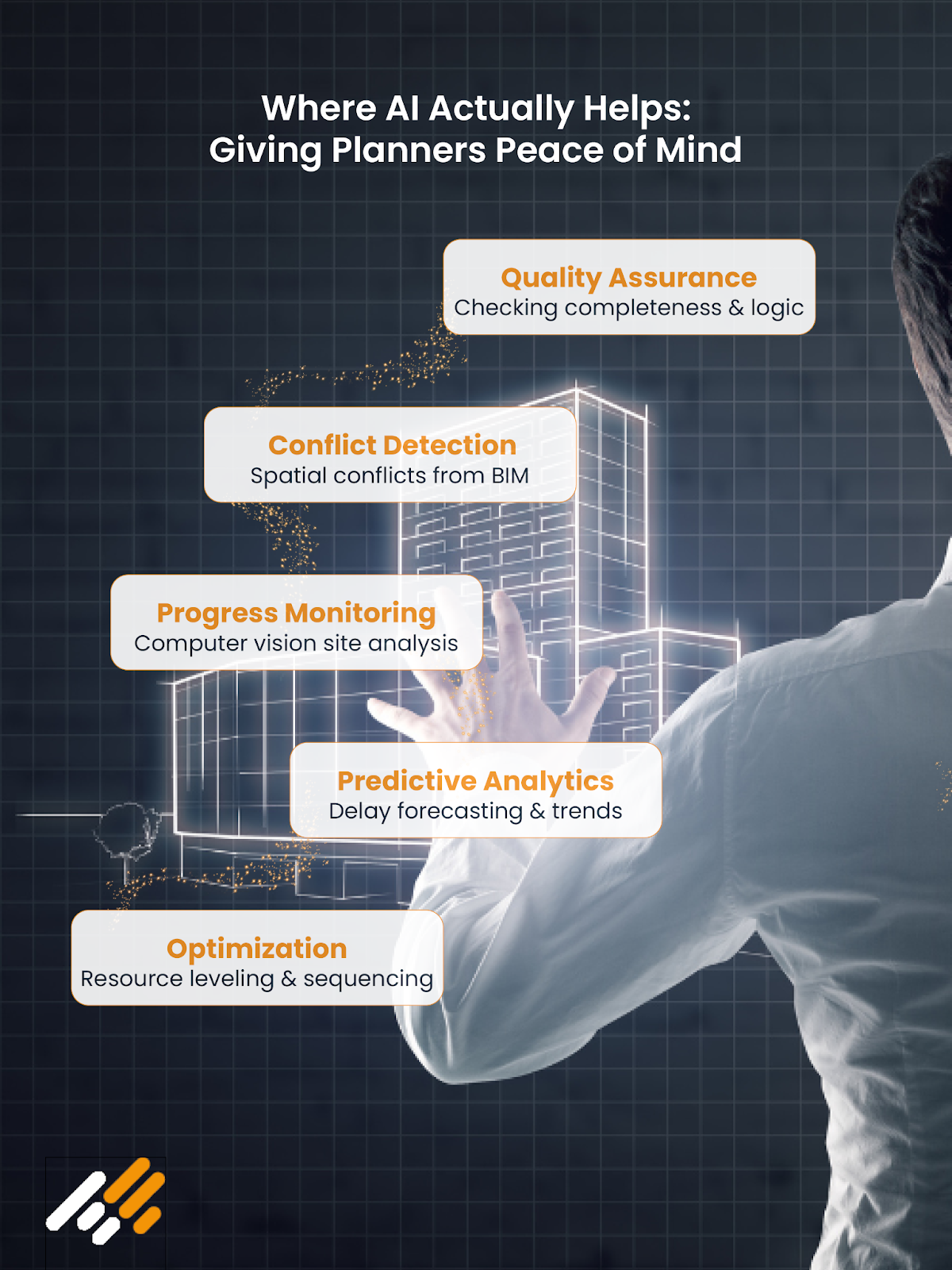
The role of technology — including AI — will focus on eliminating tedious work. "Solving the boring stuff," as Birch Pedersen describes it: quality assurance of schedules, checking for forgotten elements from BIM models, and especially progress monitoring.
"Currently, if you use scanning technologies for progress monitoring, it takes a few days from scan to progress update," he explains. "That's way too long." Future AI-powered systems will make this "even faster and more automated."
What AI Will Handle in the Near Future
- Quality assurance checking for schedule completeness and logic errors
- Automated identification of spatial conflicts from BIM models
- Progress monitoring through computer vision analysis of site photos
- Predictive analytics forecasting delays based on current productivity trends
- Optimization recommendations for resource leveling and sequence adjustments
But Birch Pedersen draws a clear line at autonomous planning: "I'm not a believer in 'blackbox scheduling' — the idea that AI can fix scheduling autonomously. Planning is a collaborative discipline. You need people's buy-in."
He's witnessed demonstrations where ChatGPT generates construction schedules. "Even if you give it the BIM model with a full copy of what you're building, it won't get all the small details you discuss in site meetings — the details from people actually doing the work."
The parallel to self-driving cars is instructive. The technology works in controlled environments but struggles with construction's complexity. "It seems possible in theory. There are tools that can develop schedules AI-based. But there's a very long way until it's really practical in real life."
What Changes for Workers: Office Work Gets Automated, Not Construction
When asked about job security in an AI-enabled future, Birch Pedersen makes a clear distinction: "It's actually all the office work that's being automated. The written work, the spoken work, the design work."
Manual construction work? "The manual construction work will most likely still be manual." Even in ten years, "bricklayers will still lay bricks, painters will still paint, and plumbers will still connect pipes."
His concern focuses on knowledge workers in adjacent fields: "Junior consultants in business consulting might not be needed anymore. The specialists will probably still be needed, and construction workers will be needed."
For construction workers, the future brings better working conditions. Early project examples already demonstrate this shift. Rather than chaotic job sites with constant conflicts and unclear priorities, integrated systems create predictable workflows where everyone knows what to do, where to be, and when to do it.
The Industry Crisis Driving Change
This transformation addresses a critical productivity crisis. According to McKinsey research from 2023, construction projects overrun budgets and schedules by 30 to 45% on average. For megaprojects specifically, 98% suffer cost overruns exceeding 30%, and 77% are at least 40% late.
These aren't acceptable variances — they're systemic failures. The construction industry's productivity has stagnated while other sectors achieved substantial gains. The financial stakes have become impossible to ignore.
The solution isn't working harder — it's working smarter with the right tools. The industry is transitioning from static, reactive planning methods to dynamic, AI-enabled integration systems that adapt in real-time to site conditions.
Companies implementing these integrated systems report 10-20% reduction in project duration and measurable improvements in resource utilization. These aren't marginal gains — they're transformative improvements that change project economics.
Real Examples: What This Looks Like in Practice
The Hotel That Proved the Method Works
Nina Fogh-Andersen stood in the construction trailer at the Wakeup Copenhagen hotel project, facing what seemed like a reasonable request. A masonry foreman wanted an additional half day for each bathroom. She entered the change into her location-based schedule.
The impact appeared instantly: the overall schedule would shift by five weeks.
"The consequence would be impossible to comprehend and illustrate with Gantt," Fogh-Andersen recalls. In her previous projects using traditional methods, finding one derived effect might require flipping to page 36 of a massive printout. "The schedule on the project filled 40 A3 pages in Gantt. With flowlines, the schedule filled one A3 page."
The mason could see the problem immediately. He left and brought in more people instead.
That instant visibility made all the difference. The Arpe & Kjeldsholm team delivered the hotel on time without requiring evenings or weekend overtime. "I realised that the method actually works! We delivered the project on time, and we didn't have to work overtime in the evenings and at weekends."
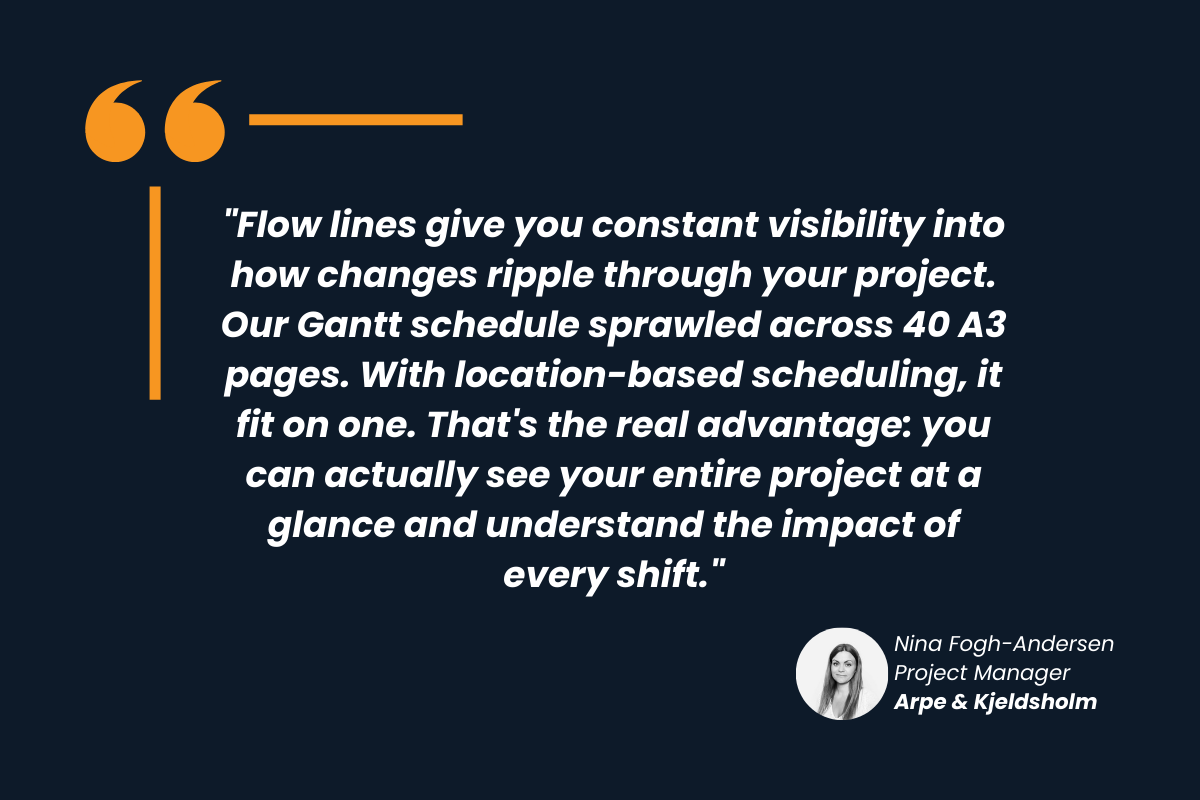
The visual clarity transformed not just planning but collaboration. "With location-based scheduling, a deviation never gets so off track that we can't catch it in time. It keeps conflict levels at the construction site at a low level while assuring the client that we will deliver on time."
Residential Project: Two Months Early
Simon Grønhøj Jensen, Construction Manager with Eurodan-huse, faced skepticism when he showed his technical director at Eurodan-huse the location-based schedule for 31 homes at Høgedalsparken. The director jokingly asked "what kind of spaghetti mess" he had drawn, referring to the flowlines visualized in Tactplan.
The results silenced doubters. Phase 1 was delivered one month early. Phase 2 finished two months ahead of schedule.
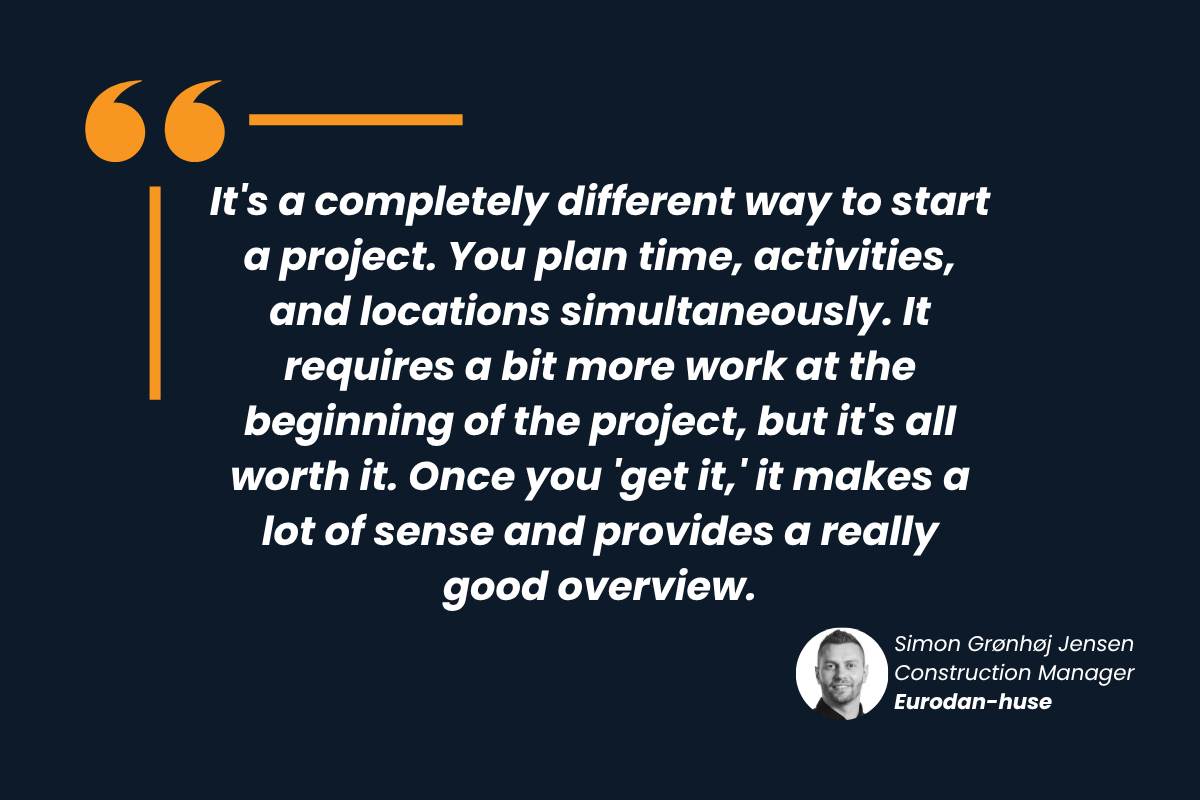
The predictability transformed subcontractor relationships. "I can guarantee the painter that he doesn't have to drive in vain because the previous contractor isn't finished on time," Jensen explains. "He can have 3 workers consistently on-site, and they can work undisturbed from house 1 to 31."
For the Eurodan-huse team, early delivery came with extremely high quality through better coordination. After seeing the results, Technical Director Christian Aakjær Jacobsen commented:
"Well done, Simon. We will definitely try location-based scheduling on more projects in the new year. You proved me wrong with those flowlines."
Portfolio Management: Seeing Three Weeks Into the Future
Helle Kvartborg manages scheduling and portfolio management for Birch Properties, overseeing multiple residential projects simultaneously. Traditional reporting gave her aggregate numbers that obscured problems:
"A report stating that the schedule is 2 months delayed and has used 90% of the total budget doesn't give a real picture of exactly where the problem lies."
Location-based progress reporting changed everything. "Because we use location-based progress reporting, we would discover the carpenter's delay immediately, not first when the delay has consequences for the subsequent electrician and painter, who either have to drive for nothing or wait."
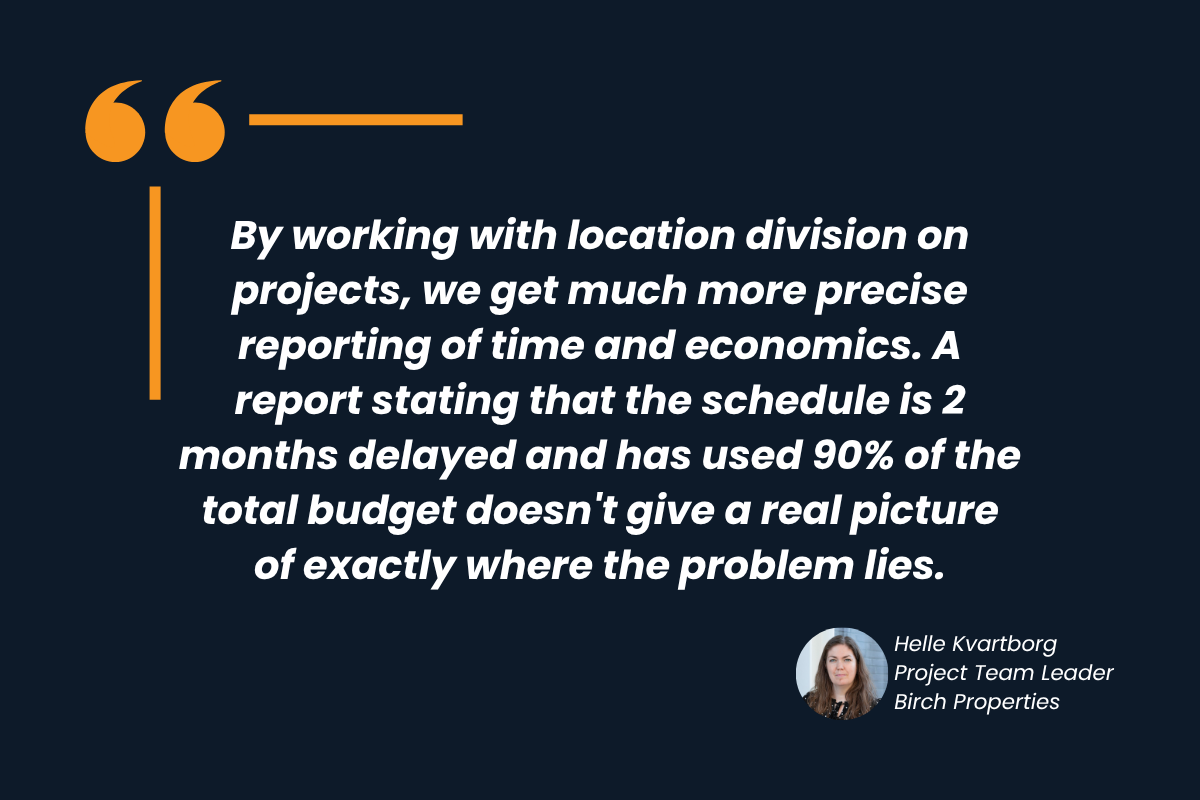
That early visibility creates intervention windows. "The key here is to discover challenges early, so we can react in time and correct the course." The financial stakes are substantial: "Looking at the complete picture, where it takes longer to make drainage, etc. due to difficult access conditions, and construction site costs must be increased due to schedule delay, it can total up to 1.5 million."
The precision builds contractor relationships. Kvartborg can provide visibility so detailed she could theoretically tell a subcontractor: "In two years from now, two of his men will be on the 2nd floor in stairwell 4 in a newly built residential building."
This precision eliminates uncertainty buffers. "This also means we don't get as many claims for extra payment invoices as before. He doesn't need to have a built-in buffer. They don't need to think 'buffers' into their collaboration — they know they can count on us, and we know we can count on them."
How Dynamic Systems Actually Work
Location-Based Scheduling: Adding the Missing Dimension
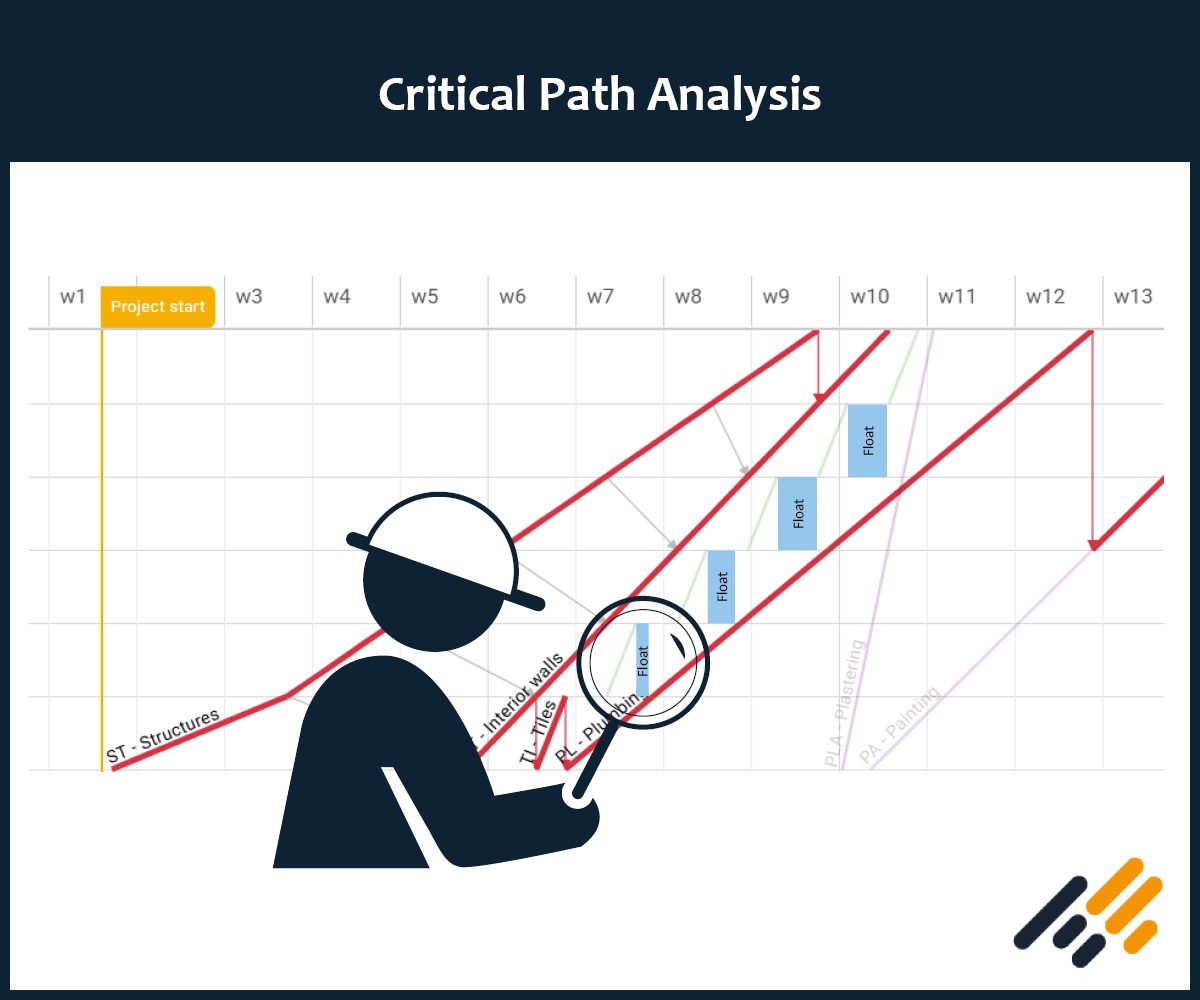
The fundamental difference between traditional and dynamic scheduling isn't sophistication — it's spatial awareness. CPM and Gantt charts show when tasks should occur but ignore where work happens.
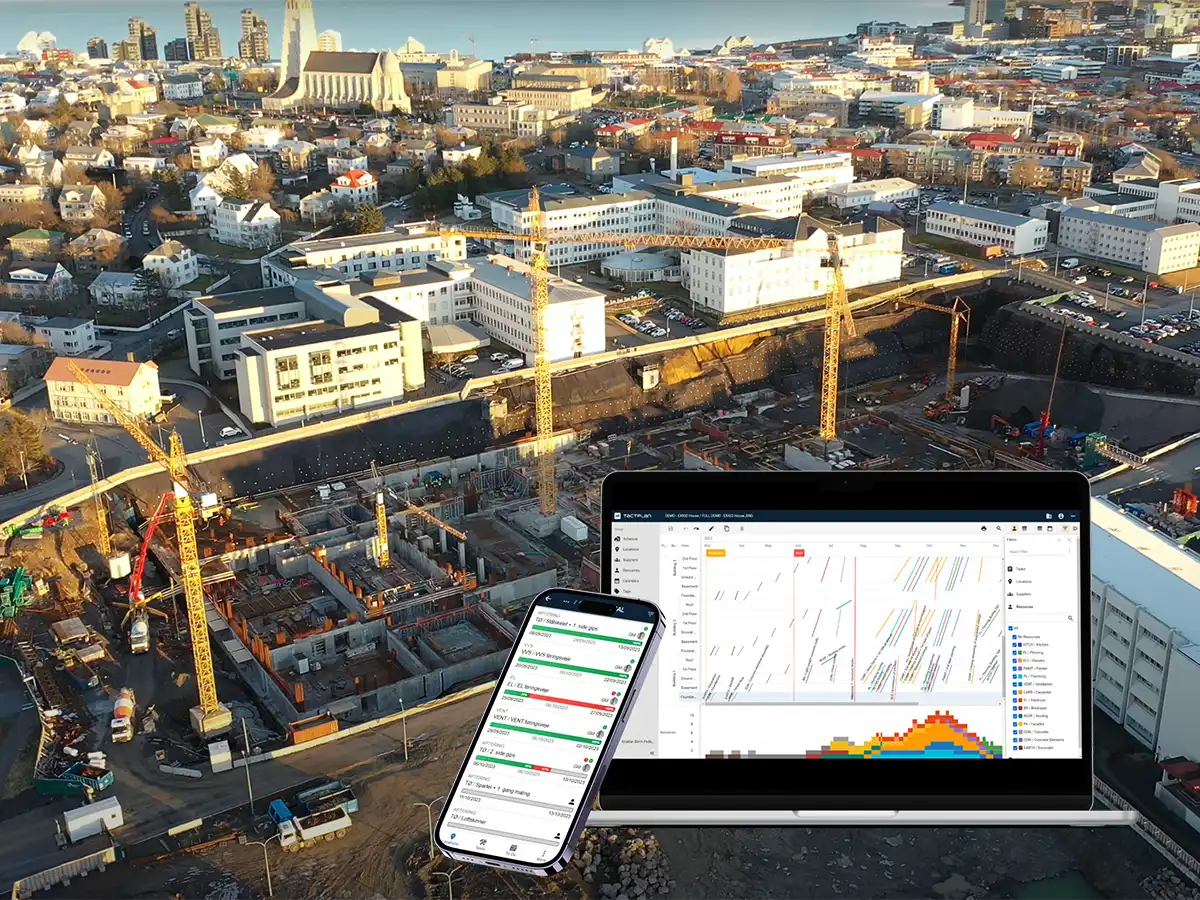
Tactplan's location-based scheduling visualizes work flow across physical building zones. When trades overlap in the same location, the system shows the conflict immediately. When areas sit empty while crews crowd elsewhere, the gaps appear visually.
Key System Capabilities:
- Automatic duration estimation from BIM quantity takeoffs
- Real-time earned value calculation linking progress to cost
- Cash flow forecasting based on location-based task completion
- Immediate impact analysis when design changes affect quantities
- Portfolio-level resource optimization across multiple projects
The integration eliminates friction. Quantities from BIM models automatically inform duration estimates. Progress updates immediately recalculate earned value. Cost data links directly to schedule completion.
Mobile Data Collection: Closing the Office-Site Gap
The office-to-site disconnect has plagued construction for decades. Schedulers develop detailed plans, but field realities diverge within hours. By the time weekly updates reach planners, problems have compounded.
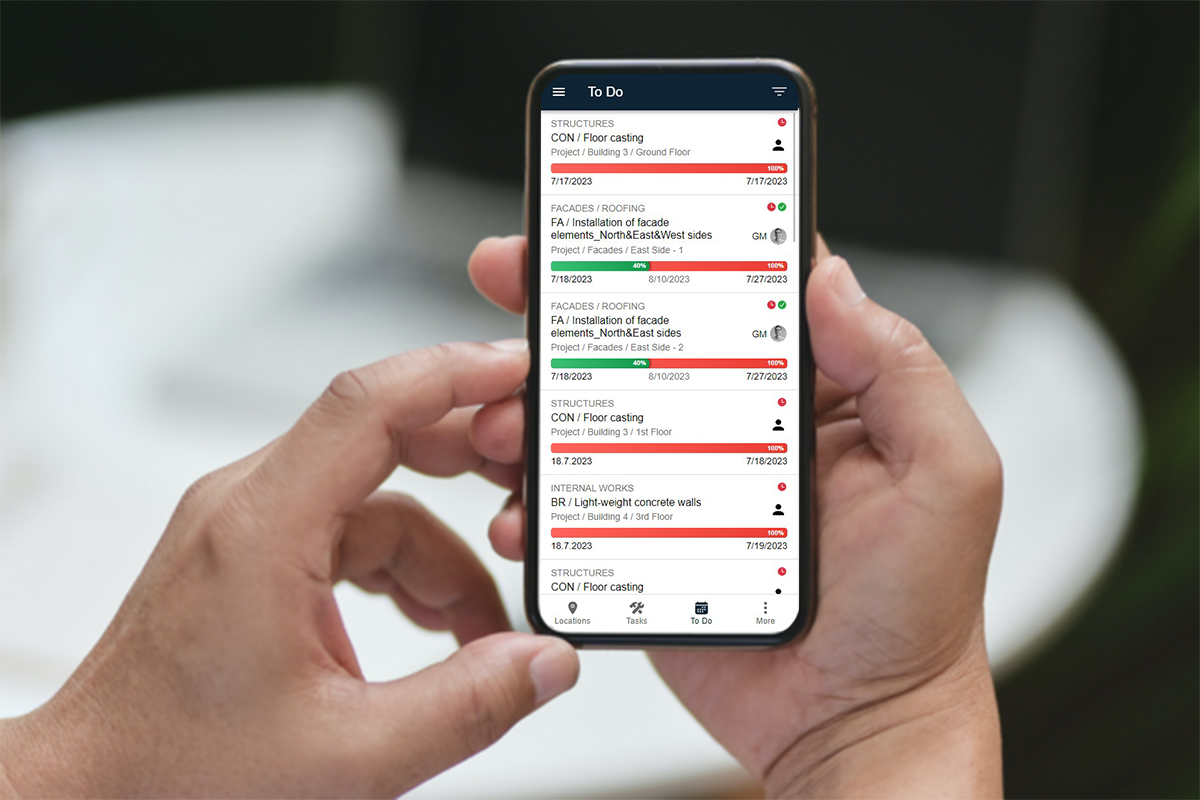
Tactplan's mobile app changes that dynamic. Site supervisors document progress, flag issues, and update task status in real-time. The platform reflects these changes across integrated dashboards immediately.
But technology alone doesn't create collaboration. The implementation methodology matters as much as the tools.
Successful implementations start with collaborative workshops involving each trade discipline. These discussions about sequence and durations build on past project data and experience, creating schedules teams actually commit to following.
The collaboration continues through structured weekly rhythms: Tuesday meetings focus on six-to-eight-week planning horizons, while Thursday sessions address the immediate one-to-two weeks. Mobile progress tracking maintains schedule currency between meetings.
Takt Planning: When Manufacturing Principles Apply
Not everything in construction benefits from manufacturing-inspired methods like Lean. "Not everything in construction can be perfectly takted," Birch Pedersen cautions. "If you do 500 hotel rooms, that can definitely be takted into perfection. But if you do a hospital where no two operating rooms are similar, or a production facility that connects to something old and existing — then it's not a perfect workflow."
The key is selective application. Repetitive work — residential units, hotel rooms, apartment floors — benefits from takt time planning's rhythmic approach. Custom work requiring unique sequences needs location-based management's flexibility.
Modern platforms integrate multiple methodologies, letting planners choose the right approach for each project phase rather than forcing all work into a single framework.
Making the Transition: Practical Implementation
Start Small, Document Results
"Organizations shouldn't attempt enterprise-wide rollouts. "Find one or two frontrunners who are truly passionate about planning, and let us train them for three or four hours," Birch Pedersen advises. "We'll build upon that passion, and Team Tactplan will support them with coaching and training. We hold their hands throughout the process, providing the security and stability that’s typically needed when implementing new processes."
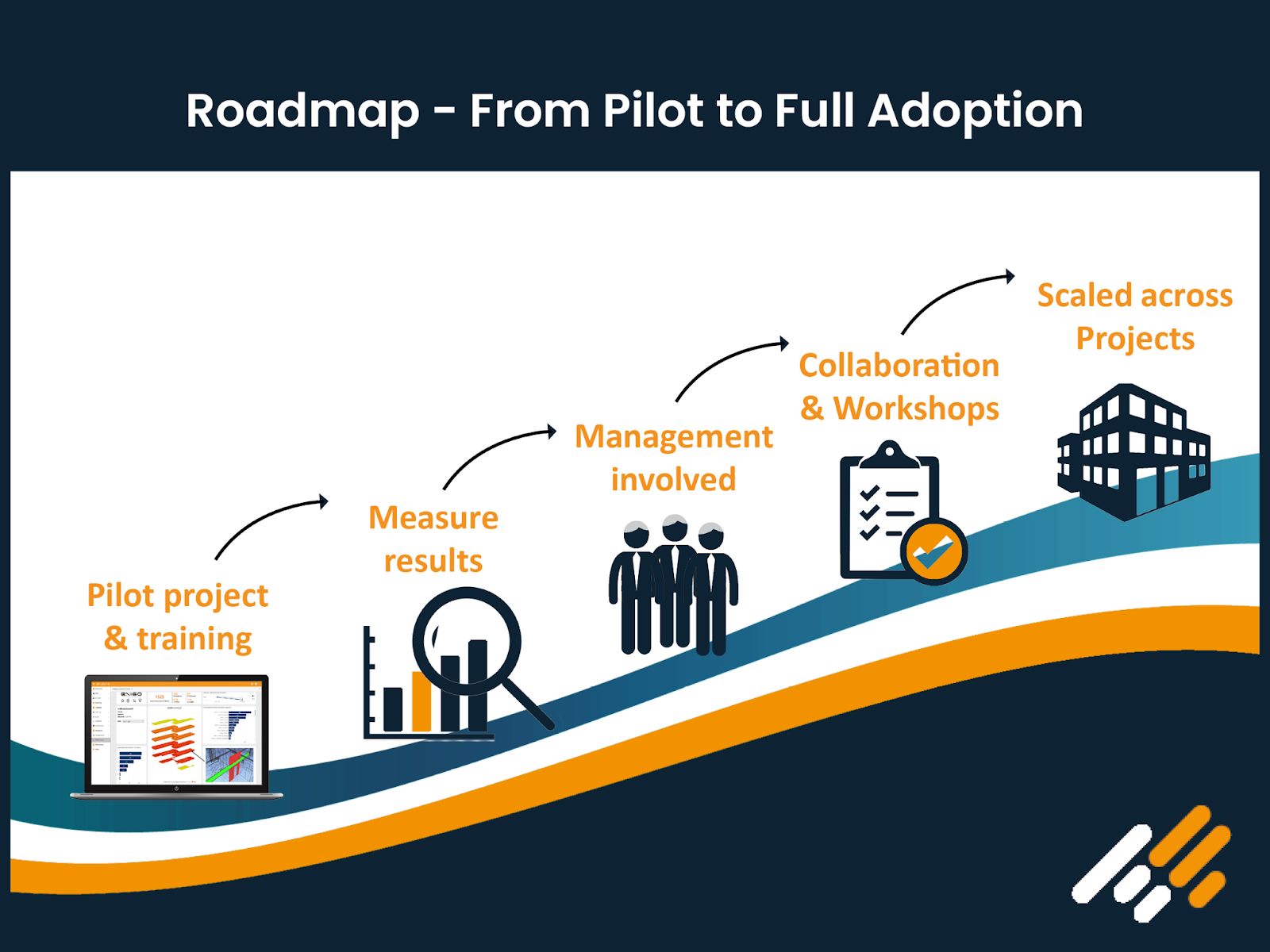
Successful companies do several things differently. "They're better at supporting it in their organization. They find the frontrunner or person with true commitment and passion, support them, and invest in wider adoption."
Crucially, involve leadership. "They don't just send the youngest guy on the course. They send their CEO and chief project managers into the same training." This ensures management understands why scheduling decisions matter and when planners need additional time for optimization.
Build the Business Case with Evidence
For organizations needing executive approval, retrospective analysis provides compelling evidence. "Take any of your old schedules and convert it into Tactplan. Then do location-based risk analysis."
This analysis reveals resource utilization problems and coordination conflicts that occurred on completed projects. "That's real-life proof on a real project." Quantify what those problems cost, add the value of earlier completion, and present the total: "Sum up that number. Then add the benefit if you'd finished in time — apartments rented earlier, factories operational sooner. Money talks in construction."
The Collaborative Foundation
Despite technological advances, construction scheduling remains fundamentally collaborative. "If you just develop your schedule in the office, that's a bad idea," Birch Pedersen states. "You need to involve the people actually doing the work."
Workshops that bring together office planners, site managers, and trade foremen produce better schedules than any algorithm working in isolation. This collaborative approach transforms not just schedules but workplace culture, creating predictability that benefits everyone.
Why Projects Fail: The Root Causes
When asked about projects running behind schedule and over budget, Birch Pedersen identifies predictable patterns. "A lot of them, especially in public projects, are unfortunately under-budgeted from the beginning."
But even adequately funded projects struggle with design coordination: "The design, the engineering, is not done when you need it done. And it's not detailed enough to to actually be used for building." This issue appears in virtually every troubled project.
The solution isn't just better budgets or faster design. "You should listen to the warnings you get during the initial phases of your project." Technology provides warnings about collisions, forgotten elements, and quality issues. The question is whether teams act on those warnings before small problems become expensive crises.
Early detection of issues creates intervention opportunities when solutions remain affordable. Address a resource shortage three weeks in advance, and strategic crew additions or task resequencing become options. Discover the same problem after it impacts the critical path, and only expensive crash measures remain.
The Journey: From BIM Pioneer to Software Founder
Kristian Birch Pedersen's journey from structural engineer to software founder spans two decades of construction technology evolution. In the early 2000s, as one of Denmark's earliest BIM adopters, he saw potential others missed. "I was working as a structural engineer, and I saw some potential in not just the design phase but also in the construction phase. I wanted to apply BIM to construction management as well."

That vision led to an industrial PhD exploring integration of virtual and physical worlds in construction. His research involved embedding wireless tags into precast concrete elements — pioneering work that predated the term "Internet of Things." But he discovered a crucial insight: "The technology was ready, but the industry wasn't prepared for that level of detail in construction management."
During his research, he encountered Finnish and American researchers who had digitalized location-based management methods. "They had some early prototypes of how to integrate with BIM models. That was basically the start of where we are today."
After finishing his research, Birch Pedersen returned to the construction industry, implementing location-based construction technologies through a product called Vico Office, which was later acquired by an American company. He became a partner and spent a decade rolling out location-based management across Denmark, establishing it as the primary scheduling method in the country.
But success brought concerns. "I got a bit nervous about these Americans. They stopped listening to our good ideas. They stopped innovating, stopped coming up with new solutions and improvements. I got suspecious that they would eventually pull the plug on the software. And I was right - they did."
Building Tactplan: Two Years in Secret
That frustration sparked Tactplan. Working in secret for two and a half years, Birch Pedersen's team built what the industry needed: a modern, web-based platform that made location-based scheduling accessible. "We knew we had to beat the best in the industry – ourselves and our colleagues."
Tactplan launched in summer 2022 with clear advantages: web-based, user-friendly, and built on modern technology while maintaining location-based management methodology at its core.
“With flow lines (location-based scheduling), one can constantly see the impact of a change if something shifts. The schedule on the project filled 40 A3 pages in Gantt. With cyclograms, the schedule filled on A3 page. The biggest advantage of flow lines/location-based scheduling is clearly the overview you get”.
Why the Industry Stayed Stuck for 60 Years
Construction adopted CPM and Gantt chart methods from manufacturing and aerospace in the 1960s. For decades, nobody questioned whether tools designed for discrete manufacturing tasks fit construction's continuous workflows and spatial constraints.
"There's a lot of reluctance in the industry to try new things," Birch Pedersen observes. "People optimize for their own benefits, or they're just nervous to try something else."
Institutional momentum perpetuated inappropriate methods. "They were introduced into schools and education systems, then taken over by some really powerful big companies that made them almost mandatory." In some jurisdictions, contract standards require specific scheduling formats, creating "lock-in situations" where better methods face contractual barriers.
Denmark overcame this resistance through demonstrated results. "We've managed to overcome that here by presenting better ways and showing results over a long period." It took several years to gain real traction, but location-based scheduling is now standard practice on large Danish construction sites.
Despite the Challenges: Why Construction's Future Is Bright
Despite challenges — slow technology adoption, persistent silos, budget overruns — Birch Pedersen remains optimistic about construction's future.
"Construction is a great industry to work in," he says with genuine enthusiasm. "It's fun. You see what you're working on your computer — you can go out the door every day and see your projects in real life."
The satisfaction extends beyond immediate visibility. "It's cool to build something that's standing there longer than you live."
That optimism, grounded in decades of practical implementation experience, suggests the future of construction scheduling isn't distant speculation. The technology exists. Proven methodologies are established. Companies implementing these systems achieve measurable results.
The path forward is clear: start with pilot projects, document results, build internal capability, and scale successful implementations. Organizations postponing this transition face compounding disadvantages as competitors achieve measurable performance improvements in duration, cost, and resource efficiency.
The question isn't whether to adopt dynamic integration systems but how quickly organizations can build the capability and capture the benefits.
Ready to experience the future of construction scheduling? Discover how Tactplan's location-based scheduling delivers measurable improvements in project duration, resource utilization, and team collaboration. Book a demo or start a free trial, or explore the free online academy to experience dynamic integration capabilities firsthand.