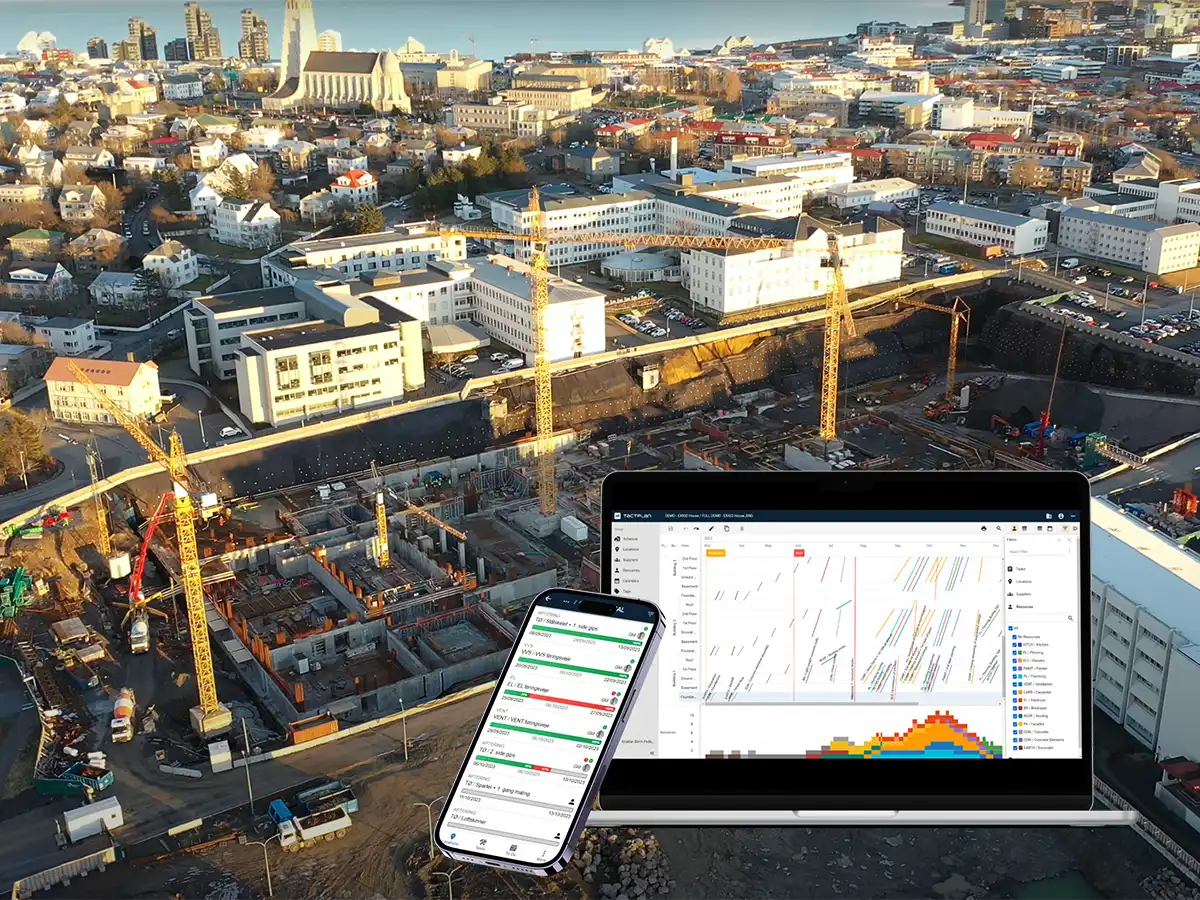
This post explores why construction schedule predictability remains elusive for most projects, what is actually driving the problem, and how a shift in planning methodology changes the financial and operational picture for developers and property owners.
A Planning Methodology Problem — Not a Technology Problem
The construction industry has invested heavily in digital tools over the past decade. BIM models have become standard. Project management platforms are widely adopted. And yet large construction projects routinely finish behind schedule and over budget — a pattern that has barely shifted in fifty years.
The reason is not a shortage of talent or tools. Most project managers and planners working in construction today are highly capable professionals. The problem is that they are operating within a planning methodology that has not fundamentally changed since the 1950s — one that was never designed to give developers or their lenders the certainty they need.
A detailed BIM model tells you what to build. It does not tell you who is building where, in what sequence, and at what pace. A traditional Gantt chart shows activities on a timeline. It does not show the physical movement of work through a building — which trade contractors are in which zones, when handoffs happen, or whether two crews are about to collide in the same location.
Construction delays rarely announce themselves in advance. They compound quietly — a late handoff here, a crew conflict there — until the programme has slipped beyond easy recovery. The planning tool should make those risks visible before they become delays. A Gantt chart, by design, does not.
That gap between what the model shows and how work actually flows is where predictability breaks down.

How Location-Based Scheduling Closes the Gap
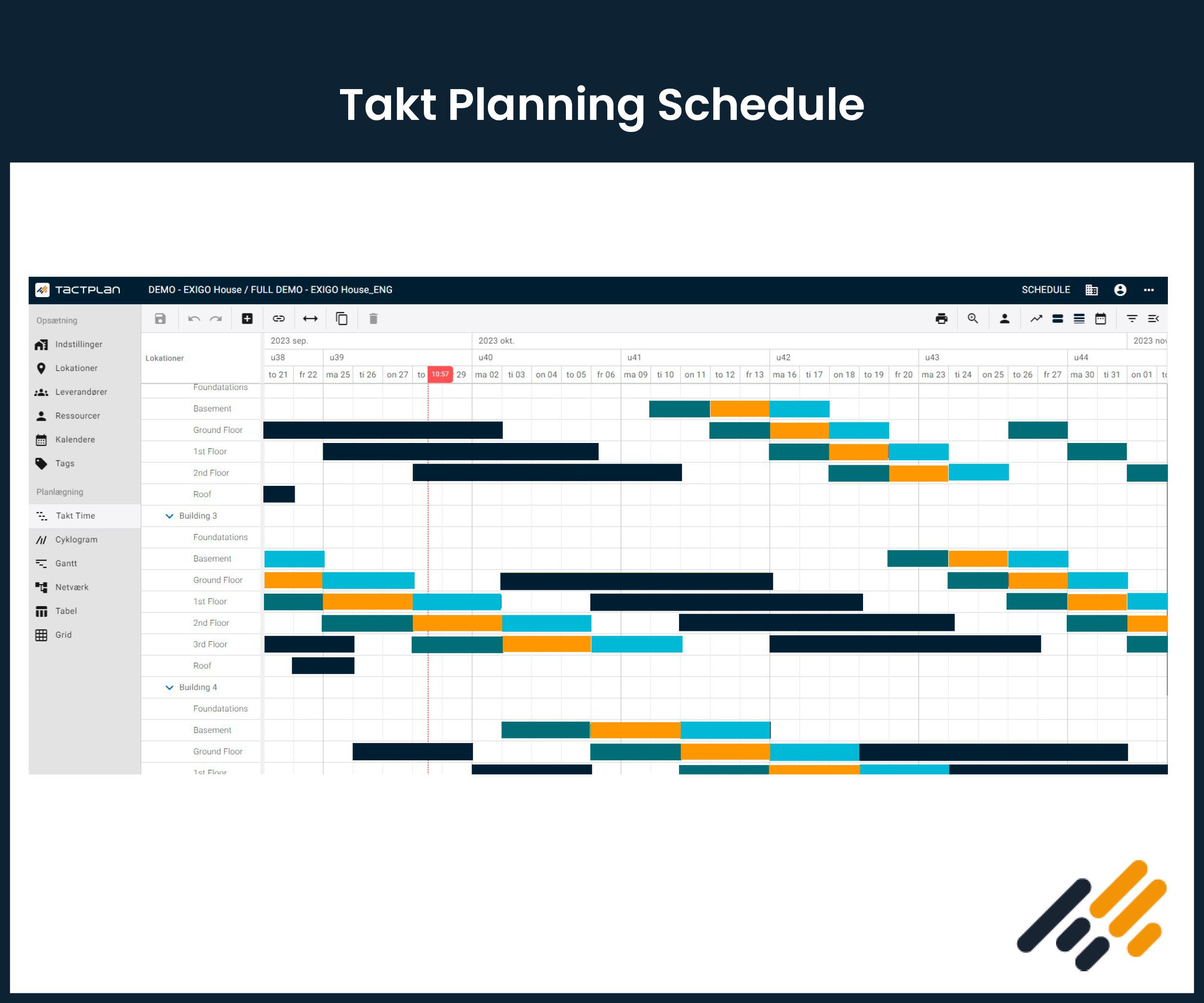
Location-based scheduling addresses this directly. By structuring the schedule around where work happens and not just when, it creates a plan that reflects how construction actually works on site:
• Trade contractors move through defined zones in a coordinated, planned sequence
• Handoffs are built into the schedule, not improvised in the moment
• Crew conflicts are visible before they happen — not discovered after the fact
• Workflow is maintained continuously rather than rebuilt after each disruption
When combined with takt time planning a lean construction principle that structures work into a consistent, repeatable rhythm across locations the effect compounds. Every trade contractor knows what to do, where to be, and exactly when to hand over to the next crew. This is the core of lean construction applied in practice: eliminating waiting time, preventing rework, and keeping every zone moving forward on schedule. The schedule stops being a document updated after things go wrong. It becomes the tool that prevents things from going wrong in the first place.
What This Looks Like in Practice
Nina Fogh-Andersen, site manager at Arpe & Kjeldsholm, faced exactly this challenge on a project in Carlsberg Byen. Modern documentation requirements like fire safety inspections, commissioning procedures, third-party sign-offs mean that a building must be physically complete up to six months before the handover date. An occupancy permit cannot be issued until every inspection is documented, submitted, and approved.
The practical consequence shows up in the smallest decisions. A carpenter asked whether he could wait a week before fitting door leaves in a stairwell. Reasonable in isolation, but Nina could see in her location-based schedule that stairwell measurements were already planned for the following day. Without the door leaves, door closers, and sealants in place, the commissioning test could not proceed. One minor delay by one trade contractor had the potential to push back the entire documentation sequence.
"I can guarantee the client that the new documentation requirements will not affect the move-in date. If the documentation is not in order today, the client is fully entitled to withhold payment. They are carrying a risk." — Nina Fogh-Andersen, Site Manager, Arpe & Kjeldsholm
That guarantee is only possible when the construction schedule and the technical documentation schedule are integrated into a single location-based plan so that dependencies between physical work and required sign-offs are visible before they become problems.

The Cash Flow and Lending Dimension
For developers and investors, the implications extend well beyond programme certainty.
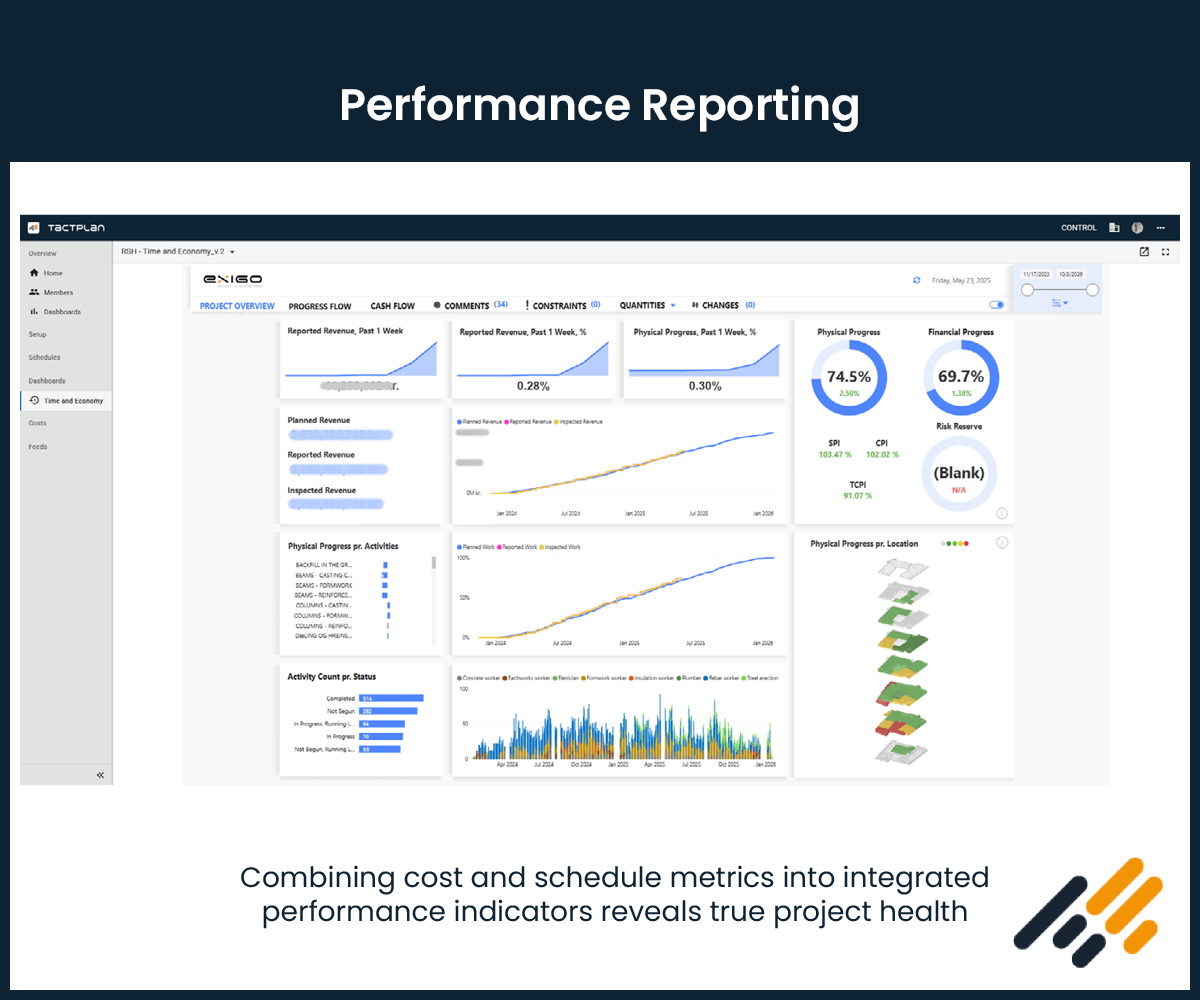
When a schedule is built on real production rates — quantities, resources, and defined locations — it becomes possible to model cash flow with genuine accuracy. You can see when costs are expected to occur, not just estimate them. You can calculate earned value in real time. You can identify well in advance where a delay in one zone will affect invoicing in the next.
Financial visibility at this level changes the relationship between a developer and their lender. It moves the conversation from managing surprises to making informed decisions together. Construction risk management identifying and responding to deviations before they become cost events becomes possible when the schedule reflects reality rather than optimism.
Kristian Krabbe, project manager at JCN Bolig, puts it from the contractor side: many clients now explicitly request controlled schedules rather than plans that drift off course. Location-based scheduling is what makes that kind of rigorous control possible — not as a promise, but as a documented, visible reality that both contractor and developer can read from the same plan.
V8 Construction, a Danish residential contractor, takes this further. By delivering projects approximately one month ahead of schedule as a consistent outcome, they have converted schedule certainty into a direct financial argument: earlier handover means earlier revenue for the developer, and earlier release of project financing. The investment in reliable planning pays for itself on every project.
What Developers Should Look For
Not every contractor who claims to plan well actually plans in a way that produces reliable delivery. As a developer, there are clear indicators worth examining before a contract is signed.
A contractor using a location-based planning methodology should be able to show you a single-page schedule that maps trade contractor movement through zones across the full programme and not a document requiring a specialist to interpret. They should be able to demonstrate the knock-on effect of any change in real time. And they should be able to show how progress is tracked against the plan — not just reported as a percentage complete.
The owners and developers section outlines what reliable delivery looks like from a client's perspective and what to expect when a contractor is working from a location-based schedule rather than a traditional Gantt.
The Barrier Is Familiarity, Not Methodology
Location-based scheduling and takt planning are not new ideas. The practical and academic foundations of lean construction have been established for decades, and the results are well documented on real projects across the Nordics, Europe, and beyond.
What is still missing is consistent adoption. The barrier is a belief still widespread in construction: that unpredictability is simply part of the work. That construction delays are an inherent characteristic of complex projects rather than a consequence of how those projects are planned.
NCC, one of Scandinavia’s largest contractors, delivered the Nicolinehus project in Aarhus — a DKK 1 billion contract, 65,000 sqm — on time. Project Manager Henrik Lindberg describes it directly: a schedule with 25,000 activities that in Gantt would fill 250 pages fits on a single page in a location-based schedule. More importantly, the continuous risk analysis built into that method means challenges are visible as the plan is built and not after they have already caused delays. Construction projects planned that way perform in ways that developers and their financial partners can rely on.
That is not a distant aspiration. It is what reliable planning already produces, on live projects, today.
Conclusion
Construction predictability is not a bonus feature. For developers, it is the single most important output of any project — handover dates that hold, cost profiles that reflect reality, cash flow that a lender can underwrite.
The methodology to produce that kind of certainty, reliably and repeatedly is location-based scheduling combined with takt planning. It has been refined through 15 years of hands-on practice on real projects in the Nordics. The tools to implement it are available today.
The question is simply whether the projects you are commissioning are being planned that way.
Ready to see what predictable construction delivery looks like in practice? Book a demo or start your free trial.