There is often a discussion about the difference between location-based scheduling (LBS) and takt planning. But perhaps we are asking the wrong question.
In our experience, takt planning is not really an alternative to location-based scheduling. It is a subset of it.
All takt plans are location-based schedules. Not all location-based schedules are takt plans.
Put simply, takt planning is location-based scheduling, but with constraints.
For a project director, this is more than terminology. It decides whether the rhythm in the schedule is one the site can actually keep, and whether the plan creates calm, predictable workdays or a steady stream of surprises.
What location-based scheduling models, and what takt adds
Location-based scheduling has its roots in the line-of-balance method, later developed into the Location-Based Management System by Russell Kenley and Olli Seppänen. The project is broken down into locations, and each trade is planned as a flow through those locations based on quantities, production rates and crew size. In a flowline view, each trade becomes a line across the building, which makes collisions and gaps visible long before they reach the site. Takt planning keeps that foundation and adds a set of deliberate constraints on top. If you are new to the method itself, our guide to takt time in construction covers the formula and the core terms. Here, we focus on how the two approaches relate.
Every row in the right-hand column is a choice made to create rhythm. The rest of this article is about what happens when those choices ignore the left-hand column.
Both approaches recognise something that traditional activity-based scheduling often struggles to represent: construction does not just happen in time. It happens in time and space. Crews move through a building, production rates matter, and two activities cannot simply occupy the same location because a schedule says they can.
Takt is often described as a time-driven method, and its focus is indeed a common rhythm in time. But that rhythm is always defined across locations. That is the layer takt adds: rhythm.
The project is divided into takt zones, work is balanced into work packages, and crews progress through those zones according to a common takt time. When it works, the result can be remarkably simple and predictable.
And that simplicity is extremely powerful.
But it can also become the problem.

The building does not care about your takt time
When designing a takt plan, there is a natural tendency to size zones according to the work.
If a crew can complete a certain amount of work in five days, we can define a zone containing approximately that amount of work. Other trades are balanced against the same five-day takt, and eventually we have a beautifully synchronised production system.
On paper.
The problem is that the building already exists as a physical system (at least as a design) before we draw our takt zones.
It has floors, rooms, corridors, shafts, stairs, entrances and structural boundaries. People need access. Materials need to arrive. Waste needs to leave. Cranes, hoists and elevators have limited capacity. Some areas provide access to other areas.
A mathematically perfect takt zone can therefore be a terrible production zone.
The building does not care about your takt time.

Production flow is also physical flow
A takt plan may show crews moving perfectly from Zone 1 to Zone 2 to Zone 3.
But the workers are not the only things moving.
Where are the materials stored? How do 40 plasterboards reach Zone 3 Tuesday morning? Can two trades simultaneously use the same hoist? Where does waste go? Does completing one zone block the access required to execute another?
We can create something that looks like perfect production flow on a screen while creating impossible physical flow on site.
This does not mean that takt is wrong. It means that location cannot merely be a variable used to achieve takt.
Location itself is a constraint.
And then there are the people
Perhaps the biggest simplification happens when we balance resources.
Twenty man-days are very easy to move around in a spreadsheet.
Twenty man-days in construction are not.
Four electricians are not necessarily four interchangeable production units. One may have specific competencies. Another may know a particular system. One may be an apprentice. Certain work may require certifications or specialist knowledge.
Neither can we necessarily solve an imbalance by changing the crew size.
If an activity requires three carpenters for five days, we cannot automatically turn that into six carpenters for two and a half days simply because the mathematics works.
The trade contractor may have four carpenters assigned to the project.
Period.
Construction workers are skilled people organised in real companies with real crews, competencies and resource limitations. They cannot simply be distributed across a production system like interchangeable machines on an assembly line.
Stable crews are also what trade contractors value most. On Eurodan-huse's 31 homes at Høgedalsparken, construction manager Simon Grønhøj Jensen planned the flow around the painter's real crew: "He can have 3 workers consistently on-site, and they can work undisturbed from house 1 to 31 in the two months we've agreed upon." Phase 1 was delivered one month early, and phase 2 two months early.
When a common takt fits, and when it does not
A shared takt works best where the building repeats itself: floor after floor of apartments, hotel rooms or offices with similar layouts, quantities and access. Here, zones of equal work tend to coincide with the physical structure, and a common rhythm is easy for every trade to follow.
It becomes harder where locations differ. A building with a large ground floor and smaller upper floors, a renovation with varying existing conditions, or an infrastructure project stretched along a route rarely produces zones that are both equal in work and sensible in physical terms. Forcing a common takt then means either drawing zones that ignore the building or adjusting crews that cannot be adjusted.
In those situations, a location-based schedule without a fixed takt can still create flow. Each trade moves through the locations at a realistic production rate, the schedule shows where trades would collide, and the plan is adjusted before that happens on site. Takt can then be introduced where the project genuinely repeats (for example, on the typical floors) while the rest follows location-based logic.
The useful question is therefore not whether to choose takt or location-based scheduling, but where the building allows a common rhythm and where it does not.

Start with reality, then create the rhythm
None of this is an argument against takt planning.
Quite the opposite.
Takt can provide an extremely powerful framework for creating understandable, predictable production. But the takt should emerge from an understanding of the production system, not the other way around.
Before asking "How should we divide the building to achieve our takt?", perhaps we should first ask:
- Where can the work physically be performed?
- How can people, materials and equipment actually move through the building?
- Which crews and competencies are genuinely available?
Only then should we ask how that production system can be balanced into a useful rhythm.
That is why we see takt planning as a subset of location-based scheduling rather than an alternative to it. Takt deliberately introduces additional constraints to create rhythm and predictability.
Those constraints can be incredibly valuable.
But only if they respect the constraints that were already there.
Do not divide the building into takt zones and then ask how to build them. Understand how the building can actually be built — and let that define the rhythm.
A calmer plan starts with the building
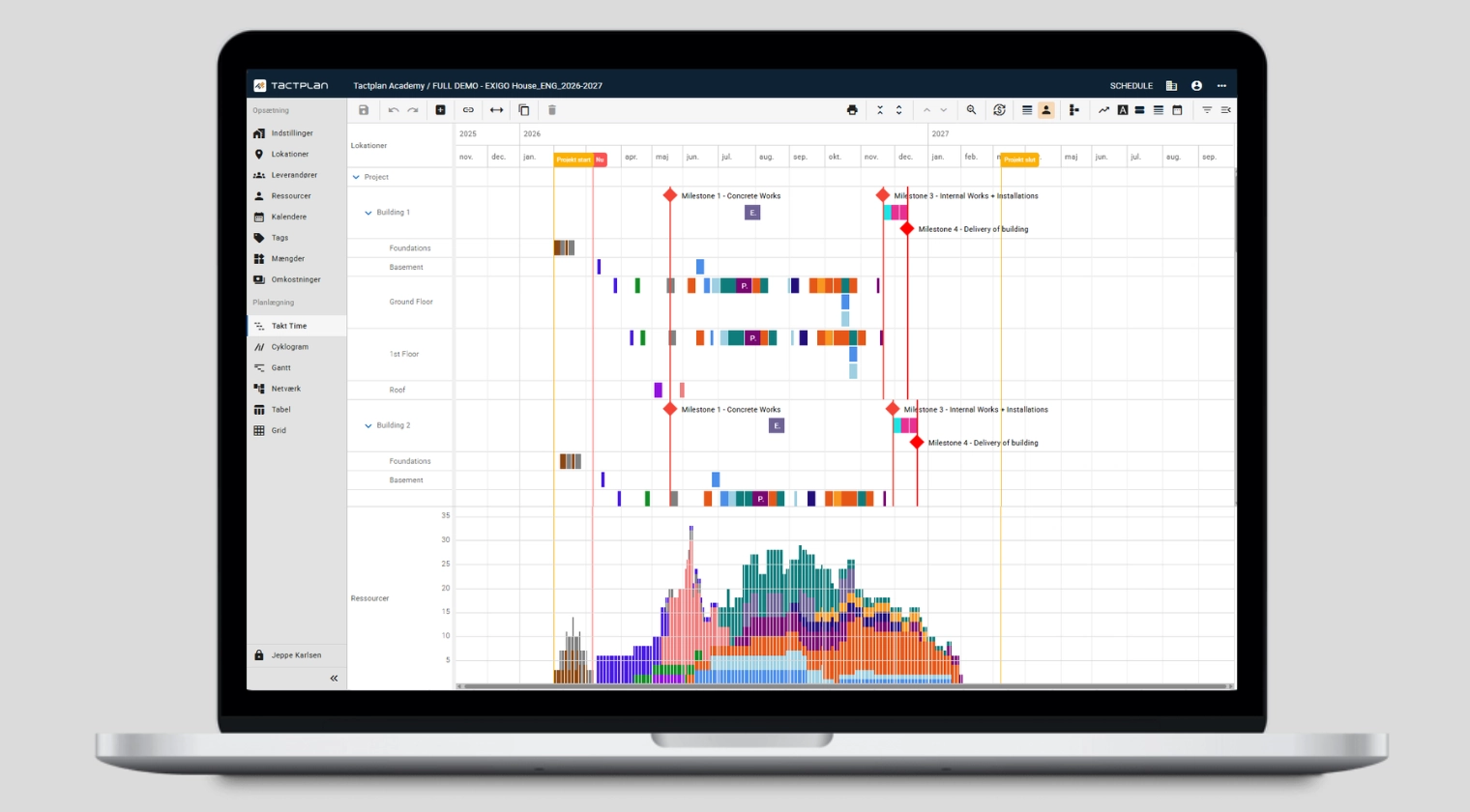
At Tactplan, we have planned this way for 15 years: locations first, then logistics and crews, then rhythm. Tactplan brings location-based scheduling, takt planning and Gantt together in one platform, so a common takt can run where the building repeats while the rest of the project follows its own realistic flowlines.
If you want to plan your next project this way, book a demo with one of our specialists or start a free trial.